
The best things to do in Kyrgyzstan
Discover the best things to do in Kyrgyzstan, from hiking alpine mountains and exploring pristine lakes to experiencing nomadic culture.
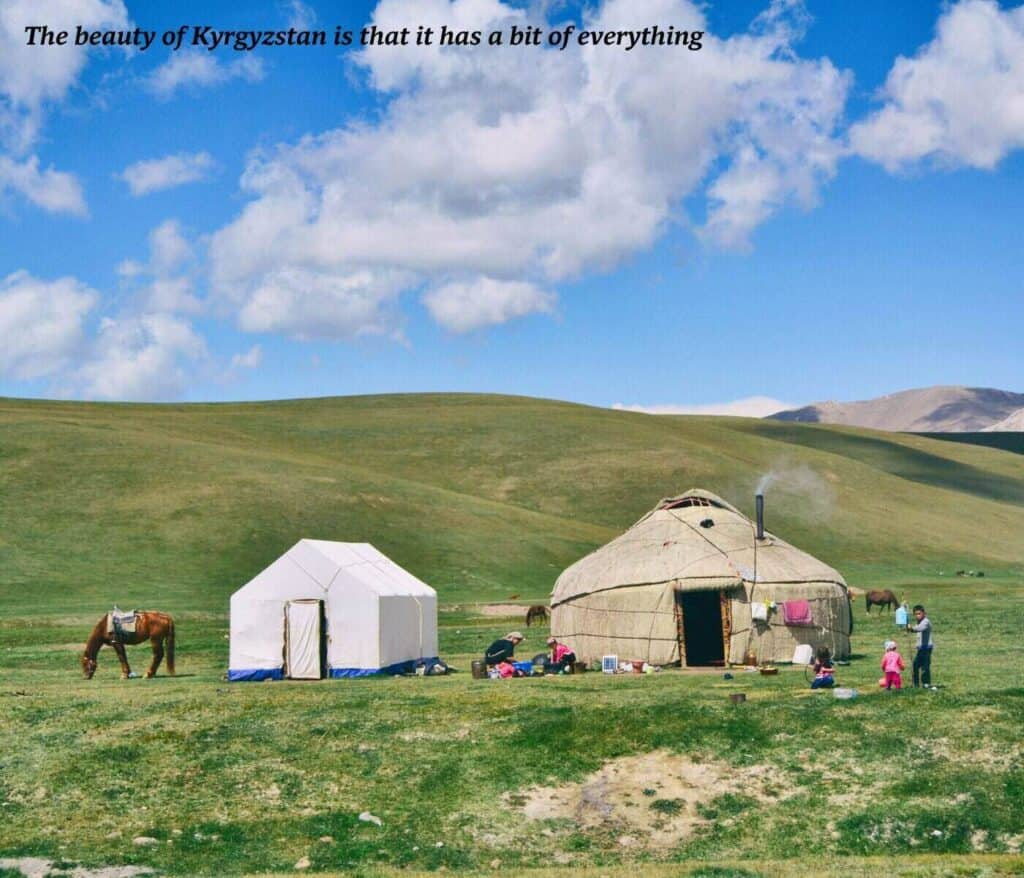
The beauty of Kyrgyzstan is that it has a bit of everything: spectacular mountain landscapes, pristine alpine lakes, rich nomadic traditions, fascinating Silk Road history and a culture shaped by centuries of Central Asian influence.
Despite becoming more accessible in recent years, much of the country’s rural life remains unchanged, with traditional yurts dotting high summer pastures and golden eagles soaring above remote valleys. A visit to Kyrgyzstan can be as adventurous as you want it to be, whether that means relaxing on the shores of Lake Issyk-Kul, trekking through the Tien Shan Mountains, horse riding across vast meadows or discovering ancient caravan routes.
This article explores the very best things to do in Kyrgyzstan, from spectacular natural wonders and cultural landmarks to unforgettable outdoor adventures.
Get our guide to Kyrgyzstan
Before you delve into the article, check out the Kyrgyzstan guidebook that inspired it:
Things to do in Kyrgyzstan
Visit Tash Rabat
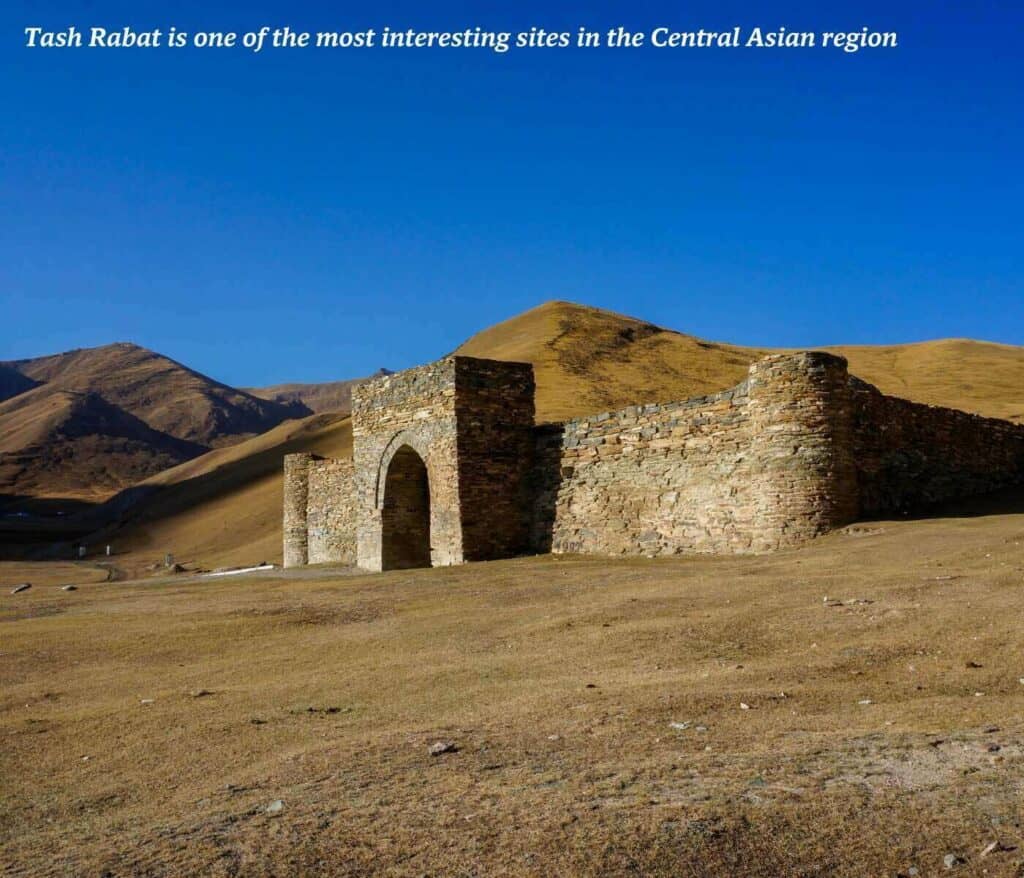
Tash Rabat is probably Kyrgyzstan’s most remarkable monument; indeed, it is one of the most interesting sites in the entire Central Asian region and its presence is in complete contradiction to the popular tenet that Kyrgyzstan is all about landscapes rather than historical sites.
Tash Rabat is a Silk Road monument par excellence: a small but perfectly formed 15th-century caravanserai that sheltered an array of merchants and travellers along one of the wilder stretches of the Silk Road. Its location is even more remarkable: tucked away from sight, half-buried in a hillside, up a valley at 3,530m above sea level.
The building is entirely stone-built, half-sunken into the hillside from which it emerges almost organically like a rocky outcrop. It is a broad rectangle in shape, measuring 36m long but looking smaller from the outside because some of its internal structure lies beneath the hillside. The front entrance leads into a central hall that is surrounded by a network of small rooms, about 30 in all, which were used as bedrooms, prison cells, pantries and prayer rooms.
You can read more about Central Asia’s Silk Road sights here.
Our recommended Kyrgyzstan operators
Independent travel in Kyrgyzstan is possible, but experienced guides can make all the difference when exploring remote mountain landscapes or gaining a deeper understanding of the country’s rich nomadic culture.
Here are some of our favourites:
Hikes from Tash Rabat
Tash Rabat is a good base for hikes or horse rides. Horses may be hired from the Tash Rabat caretaker, who charges around 300 som per hour and who can provide a guide for 2,500 som per day if required.
One classic hike or ride from Tash Rabat is the ascent to the ridge of the At-Bashy Range that overlooks Lake Chatyr-Köl, a tough 4–5-hour climb or 7–8-hour round trip. The ridge is at almost 4,000m and so offers wonderful views over the lake and the wide Ak-Say Valley. Naturally, the altitude makes for hard work, and the weather can be very changeable too, with snow or sleet a possibility at any time of year.
The climb is demanding, but the reward is the sheer openness of the landscape, with some of Central Asia’s most beautiful scenery spread out in every direction.
Discover Saimaluu-Tash
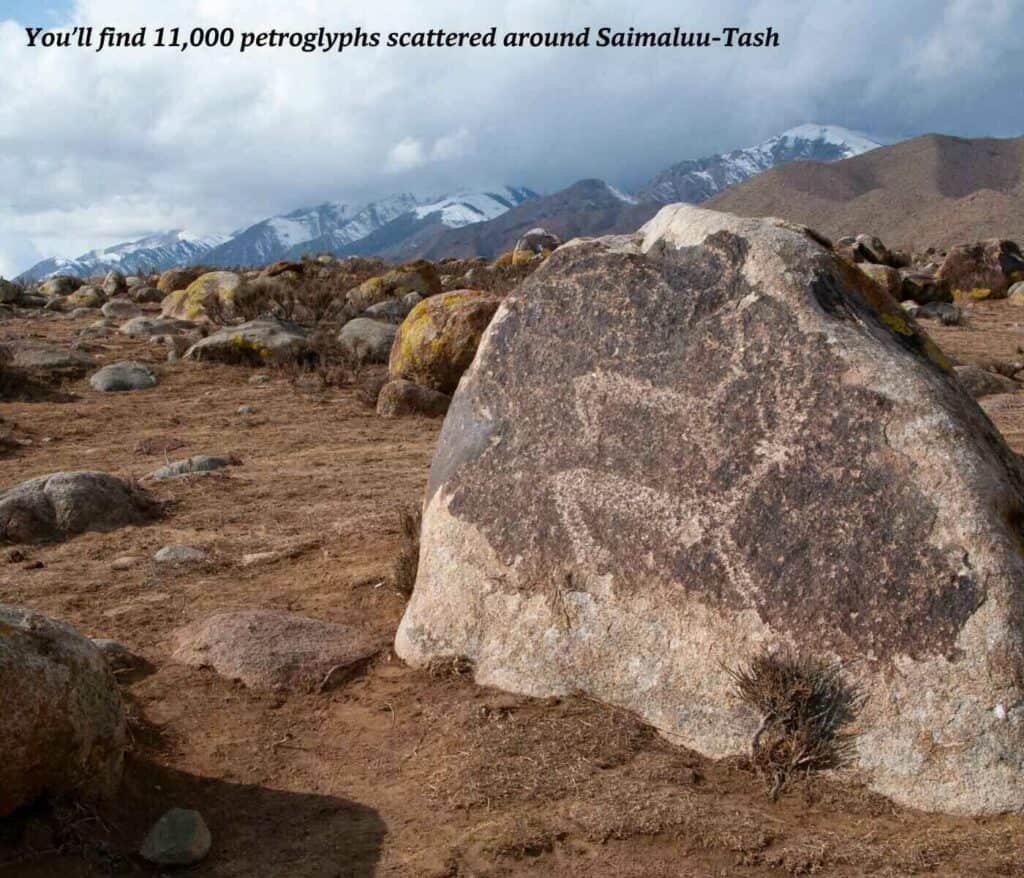
Saimaluu-Tash means ’embroidered’ or ‘patterned stones’ in Kyrgyz, and this is not a bad description for what is the most remote, and certainly the most spectacular, collection of petroglyphs in the country. Here, high on a lonely alpine plateau, are an estimated 11,000 petroglyphs scattered over the slopes of two glacial moraines that have been named by archaeologists, not very imaginatively, as Saimaluu-Tash One and Saimaluu-Tash Two. The larger of the two, Saimaluu-Tash One, measures 3km in length.
The petroglyphs, which are etched on to shiny basaltic stone, date from at least as early as 2000BC in the Bronze Age, and may well be even older. They most probably represent votive offerings that were brought to this sacred site from the valleys below. The site itself has undoubtedly long been considered to be sacred and it is believed the small pond that lies in the middle of the lower gallery was frequented by shamans.
The intent driving this artwork is as meaningful as its content. The petroglyphs are less the stone pages of a prehistoric sketchbook than they are individual acts of sympathetic magic in which the artist, in physically representing his desire – a successful hunt, a good water supply, sunshine for crops – has invoked the gods to help him: on top of a mountain at 3,200m is not a bad place to summon the spirits.
Visiting Saimaluu-Tash
Getting to the ‘Stonehenge of central Asia’, as Saimaluu-Tash is sometimes playfully referred to, is not at all easy. In the first place, it normally requires reaching Kazarman, the village that is used as the base for visits to the petroglyph site, itself a rather isolated and not altogether agreeable place.
From Kazarman, it is possible to travel some of the way by 4×4, but the rest has to be done on foot or on horseback. This is best organised with the local Kazarman CBT co-ordinator, or in advance with the CBT office in Bishkek or Jalal-Abad.
The site lies at 3,200m on top of a mountain and, although it is not technically difficult, the climb up to the petroglyphs is long and slow, perhaps 4 hours up and 3 down, and requires a certain amount of stamina. A guide is certainly necessary.
Swim in Lake Issyk-Kul
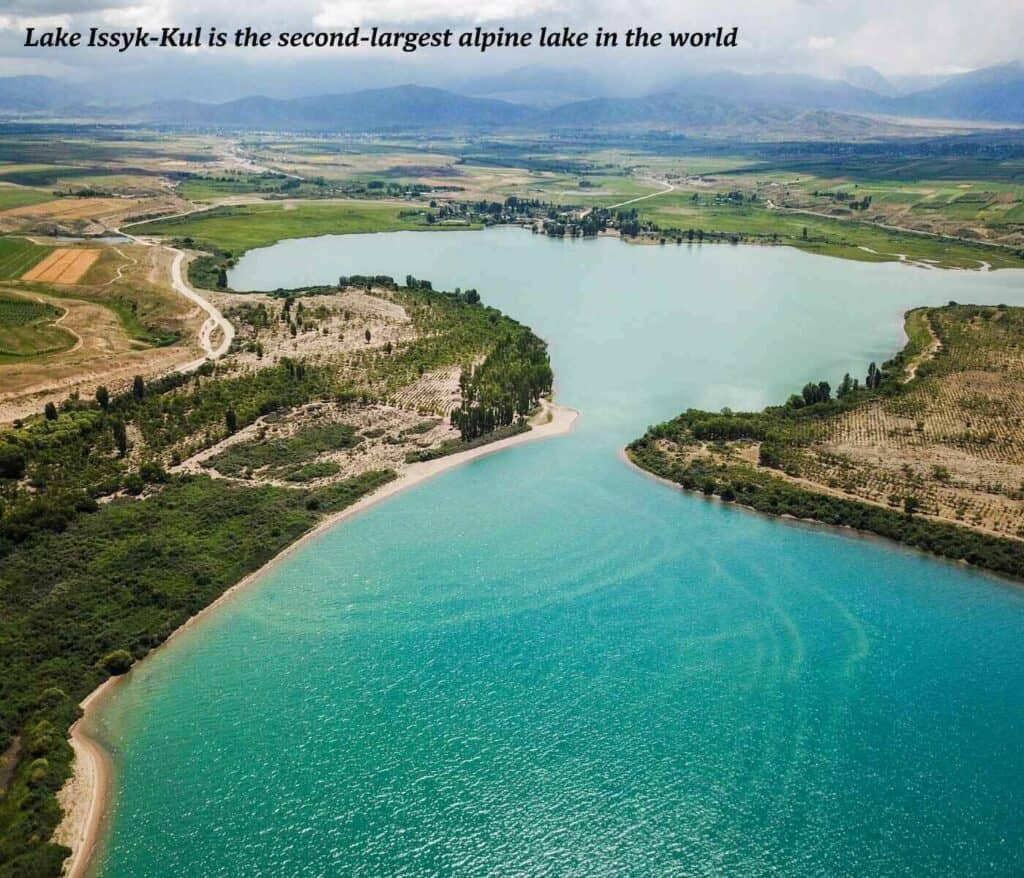
Lake Issyk-Kul, the second-largest alpine lake in the world, gives its name to the oblast that surrounds the lake’s shoreline and extends across the high Tien Shan range south to the Chinese border. Issyk-Kul Province, which in area makes up around 20% of Kyrgyzstan’s territory, has a population of just over 500,000, the vast majority of whom live around the lake’s shores.
The lakes name, which is also spelled Ysyk Köl or Issyk-kol, means literally warm lake in the Kyrgyz language, as does its Chinese equivalent, Ze-Hai. There is good reason for this: in a part of the world where winter temperatures can plummet to 25°C or worse, the shores of the lake have a microclimate that is relatively balmy and, even more aptly, its waters never freeze. This is all the more surprising considering the lake stands at considerable altitude – 1,606m above sea level.
Scientists have long debated the precise mechanics of this, and it would seem it is down to a combination of deep-water physics, slight salinity and underground thermal activity. Most locals are less questioning and are merely grateful for the respite the lake offers, assuming it is because the water is warmed by heat wafting up from the earth’s core.
Tamchy
Nestled on the northwest shore of Lake Issyk-Kul, this small village has become more and more popular with domestic and Kazakh tourists over the years as a quieter and less brash alternative to Cholpon-Ata. With a smattering of homestays and an established CBT project here too, it is also becoming increasingly favoured by overseas visitors, either as an overnight stop while travelling along Lake Issyk-Kul’s north shore, or as a place to relax after a stint of strenuous trekking. As a village it is a pleasant but fairly unremarkable place, but it does have something that most others do not have: a location right by the water and a long lakeside beach.
Tamchy’s prime attraction is its natural setting: a beachfront location with the backdrop of the mountains of the Kungey Ala-Too range. There are pleasant walks to be had along the beach in either direction. In summer there will be plenty of Russians and Kyrgyz swimming in the lake, and families picnicking on the beach or eating in the tents which have been set up along it.
Expereince nomadic life on the shores of Lake Song-Köl
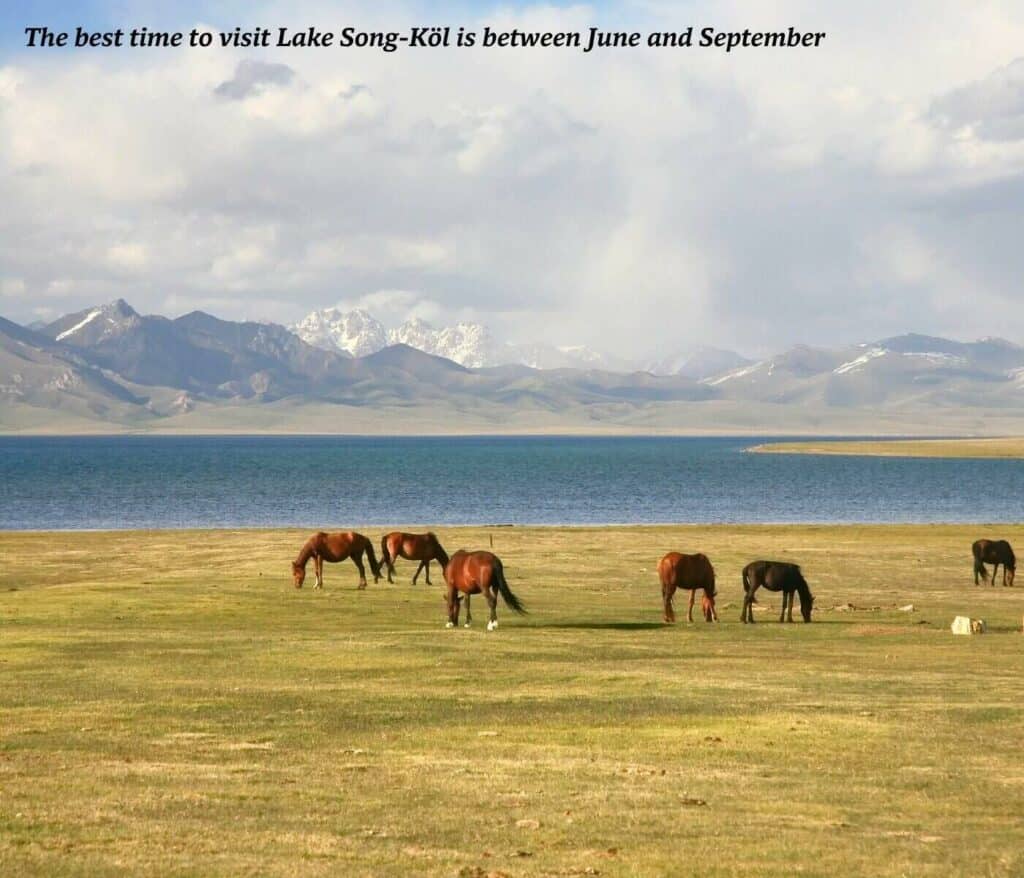
In many ways, Lake Song-Köl is Kyrgyzstan’s poster girl. The lake is an almost archetypal destination of the wilderness variety, having all of the necessary ingredients to create a picture-perfect vignette of the Kyrgyz nomadic way of life: a wide alpine lake, nomads on horseback, yurts, lush green pasture, bare snow-capped mountains and contented herds of livestock.
With the right conditions – a golden sun setting over still waters; the ring of surrounding mountains transformed into a purple velvet backdrop; unseen cattle lowing as dusk falls – it is almost too perfect to be true. Even in less than optimal circumstances – sloping rain, wind-driven sleet, an electrical storm crackling around the shore – it is still wholly exhilarating.
The best time to visit Lake Song-Köl is between June and September, although the beginning and end of the season can be very cold at night – even in August it is barely above freezing. Outside this period, there will be nowhere to stay at the lake as all of the yurts will be dismantled and the herders returned to the valleys.
A visit outside the summer months is ill-advised, not simply because of a lack of accommodation or cold temperatures: part of the Song-Köl experience is an appreciation of how Kyrgyz nomads live in tune with their environment and to experience the lake without people would not do it full justice.
- Recommended reading: the most impressive lakes in the world
Hike around Lake Sary-Chelek
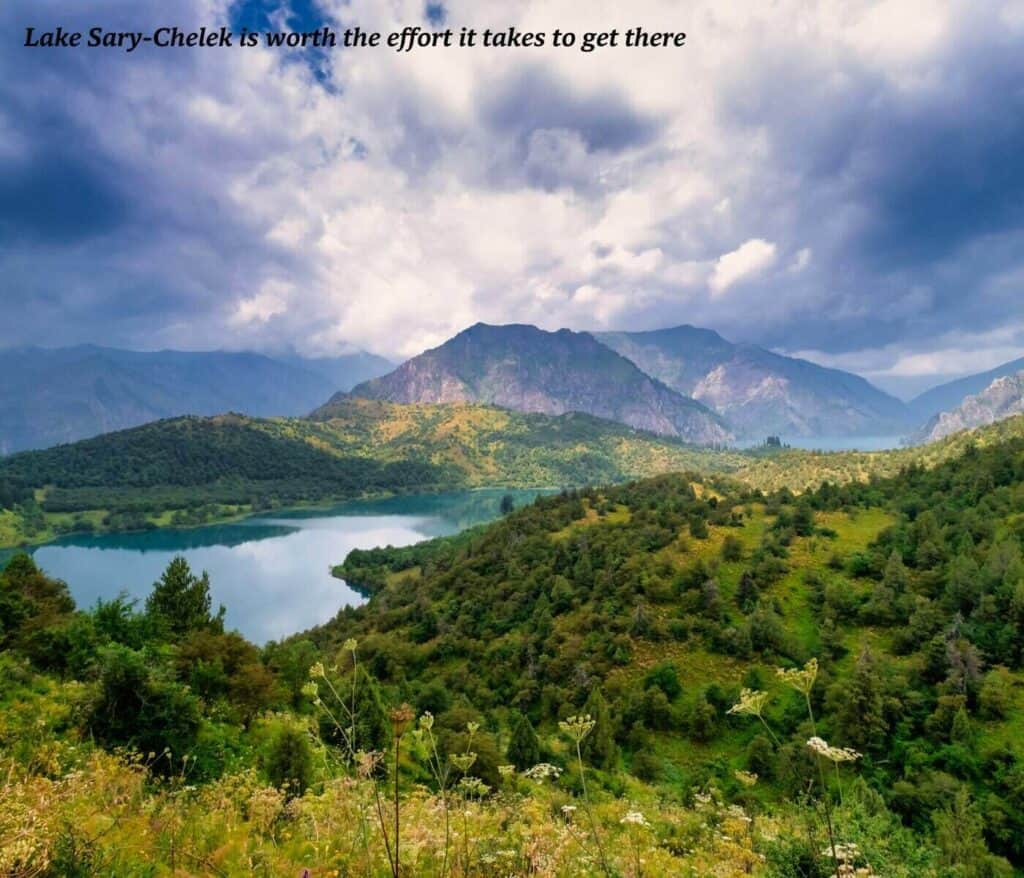
Lake Sary-Chelek is one of Kyrgyzstan’s true gems – a major draw that is a little difficult to reach but, as most visitors seem to attest, is well worth the effort. Sary-Chelek (literally Yellow Bucket’) is a fairly small, alpine lake set amid conifer, and relict fruit and nut forest at an altitude of 1,873m. The lake is just one part of the Sary-Chelek Biosphere Reserve, which has seven lakes in total and protects more than a thousand species of plants, 160 birds and 34 mammals, including rarities such as bear, lynx and snow leopard.
Its glorious alpine location among forest and rocky crags is as impressive as the lake itself, and the steep slopes that surround the lake support dense forests of pine, fir and juniper. At slightly lower elevations there are tangled stands of nut and wild fruit trees, including walnut, pistachio, apple and pear.
Although they are not strictly supposed to, many locals come to gather the fruits of the forest in this part of the reserve. Local visitors also sometimes come in large numbers to the lake on fine-weather summer weekends and the area around the car park can become very busy at such times. A midweek visit is usually preferable.
Learn more about local culture in Arslanbob
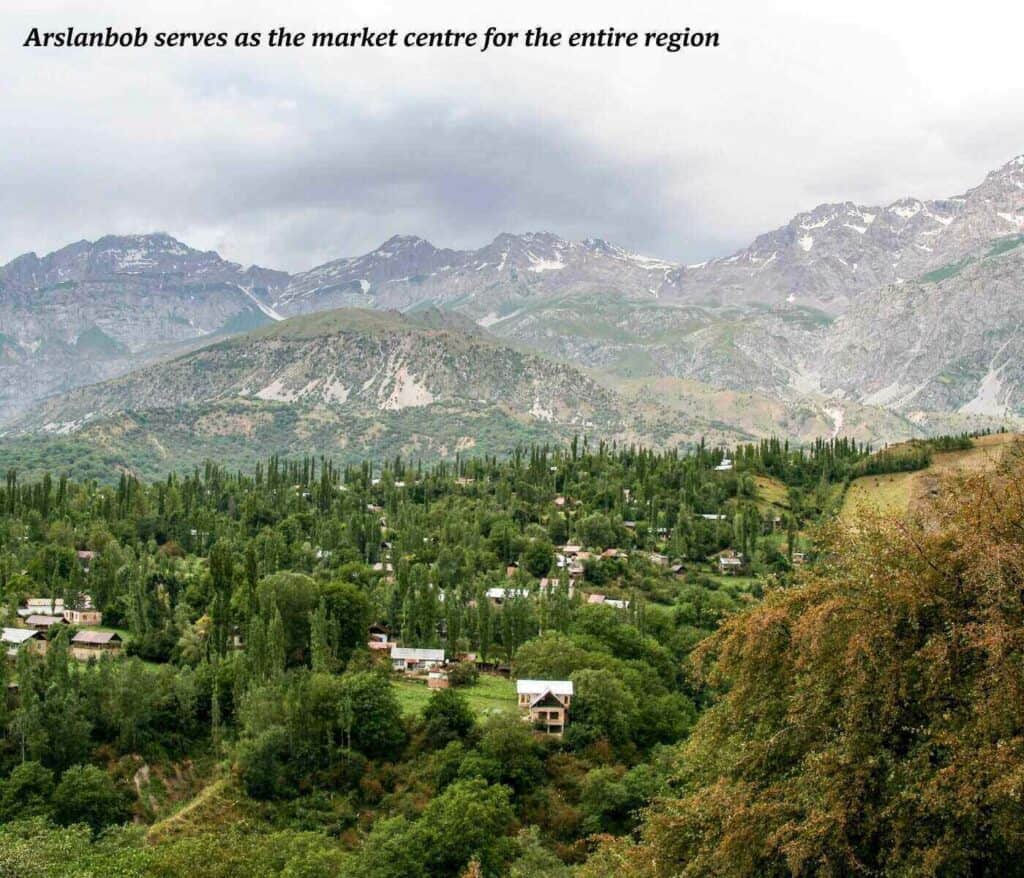
Arslanbob is central to one of Kyrgyzstan’s most remarkable regions – the vast relic walnut forest which stretches east and west of the village to cover a total area of 11,000ha. The large, sprawling village of Arslanbob serves as the market centre for the entire region as well as a summer resort with a gentle climate.
Arslanbob is actually far more than this though: unusually for Kyrgyzstan, the village itself is a highly attractive place with a population that is almost entirely Uzbek, and with gorgeous mountain scenery, friendly locals and a pioneering local CBT group, it is hard to beat as a base for hikes in the hills that surround the village or as a start or end point for more energetic treks venturing deep into the mountains.
There is plenty to do without straying far from the village. Visit the Arslanbob-Ata Shrine, one of the region’s most important pilgrimage sites, take a day trip to nearby waterfalls, or hike the surrounding hills for panoramic views across the vast walnut forest. Horse riding is another excellent way to explore the area, while those visiting in winter can arrange skiing and snowboarding with local guides and instructors, making Arslanbob an appealing destination in every season.
Read more about culture and community on our Kyrgyzstan information page.
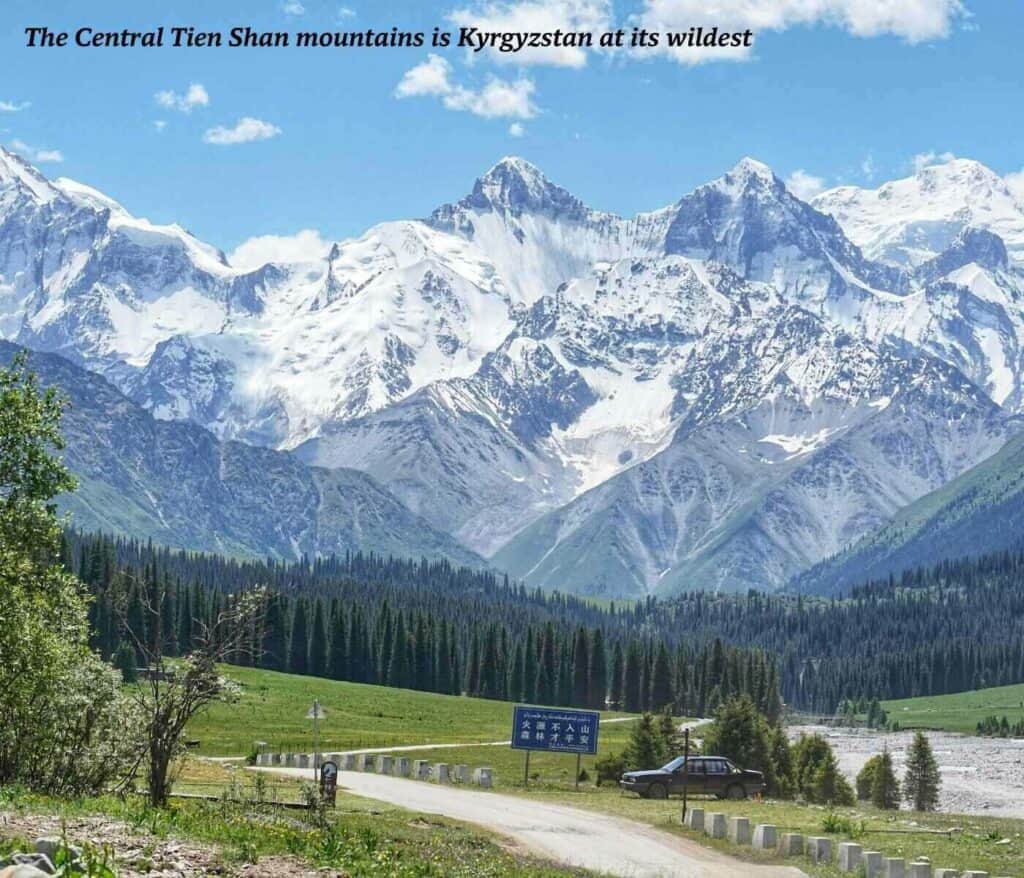
Go trekking in the Central Tien Shan mountain range
The corner of the Kyrgyz Republic that wedges itself between Kazakh and Chinese territory to the east of Karakol is indisputably the country’s wildest and least accessible region. It is in this region that superlatives abound: the highest mountains, the coldest temperatures, the longest glaciers, the grizzliest mountaineers and the strangest natural phenomena.
This is a region of ice, snow and unexplored peaks – too high and inhospitable even for most hardy Kyrgyz nomads. It is home to Kyrgyzstan’s highest peak (the second highest in the former USSR), the world’s fourth-longest glacier, an amazing disappearing lake and, if you believe in that sort of thing, the remote location for the crash landing of a giant UFO.
Unlike the valleys closer to Karakol this is no place for gentle mountain hikes and is really only for committed, experienced mountaineers and those who avail themselves of the support services of guides and porters. Whatever the degree of tactical support enlisted, fitness and stamina are essential. Visiting the area requires a considerable commitment of time, energy and money, but those returning from time spent trekking in the region invariably insist that it is well worth it.
Our guide to Kyrgyzstan
For more information, see Laurence Mitchell’s guide to Kyrgyzstan: