
Wondering where to go in Northern Ireland? This round-up of top sights and travel tips showcases the best the country has to offer.
After many years of being covered only by all-Ireland guidebooks and by thin volumes cut out of them, it’s high time that Northern Ireland had its moment in the spotlight.
But where exactly should you go?
There’s so much more to see than Belfast, the Giant’s Causeway and some golf courses – for one thing, the coast and countryside are beautiful and ever-changing, while the warmth and hospitality you’ll find everywhere will also make your visit special.
It makes perfect sense to combine a visit to Northern Ireland with the wonderful country across the border but, equally, Northern Ireland, with over a hundred years of independent existence, is very much its own place, with social and historical currents that you’re only vaguely aware of from outside the six counties.
From the windswept shores of Portstewart, to the historic streets of Armagh, here’s our selection of Northern Ireland’s highlights.
Get our guide to Northern Ireland
Before you delve into the article, check out the Northern Ireland travel guide that inspired it:
Where to go in Northern Ireland
Belfast
Belfast, which dominates the rest of Northern Ireland more perhaps than strictly necessary, is an exciting place now, casting off decades of introversion to produce great art, theatre, food and drink.
It‘s not a beautiful city so much as a city in a beautiful location, between the rugged Antrim Plateau and the rolling Castlereagh Hills, with Belfast Lough immediately to the east. The city’s name comes from Beal Feirste, meaning the sandy ford at the mouth of the River Farset – nowadays the Lagan is the river associated with Belfast, but the Farset is still there, beneath the streets (as is the Blackstaff, just to the west).
A good way to explore Belfast is to follow a walking tour of the city centre starting at Belfast City Hall, a spectacular centrepiece completed in 1906 where you can admire the grand lobbies and the excellent exhibition on the city’s history, before wandering around Donegall Square with its striking red sandstone buildings and historic banks. Nearby, don’t miss the Linen Hall Library, not just a private library but also an active cultural centre.
Head into the Linen Quarter to see Ulster Hall, famous as the venue where Led Zeppelin first performed Stairway to Heaven. From Castle Place, explore historic streets, churches and the Cathedral Quarter before heading to the River Lagan to see the universally known Big Fish sculpture and the Titanic Quarter, where Titanic Belfast justifies the hype with immersive exhibits on the ship’s story alongside the restored SS Nomadic.
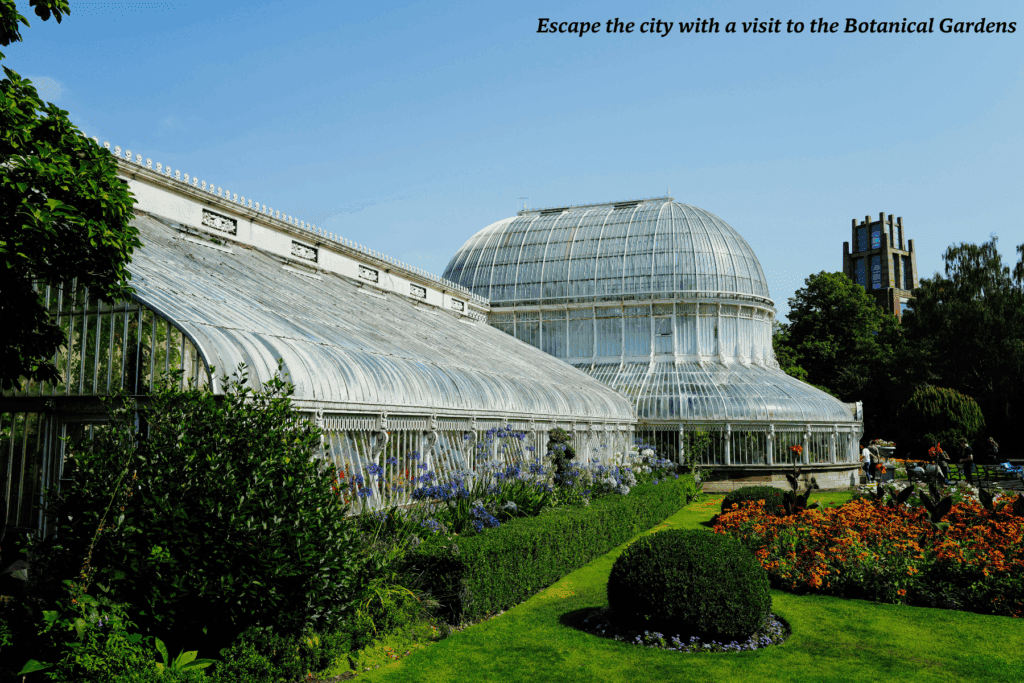
Beyond this, you can explore the student-filled University Quarter with the Ulster Museum and Botanic Gardens, or venture to the Falls and Shankill roads where murals preserve the attitudes of the Troubles era, making Belfast a city where history, culture and politics are all vividly on display.
County Antrim
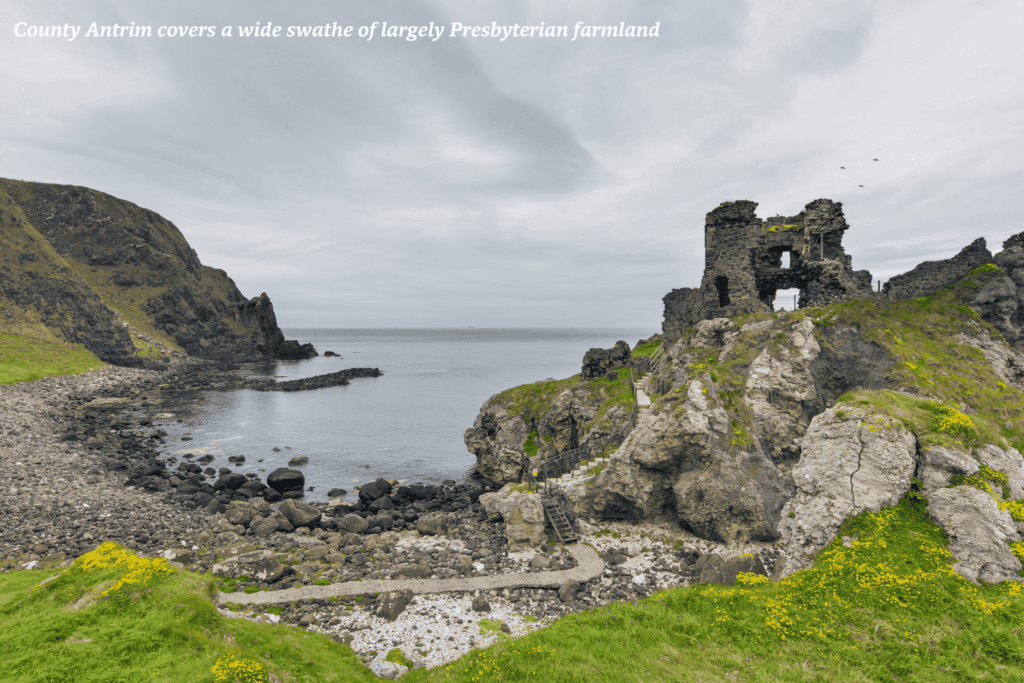
County Antrim covers a wide swathe of largely Presbyterian farmland from Belfast up to Portrush on the Causeway Coast, plus the Glens of Antrim to the east.
Its main attraction is indeed the Giant’s Causeway, which can be reached in just an hour from Belfast, but it’s well worth spending a lot more time getting there, along the Glens coast north of Carrickfergus and Larne.
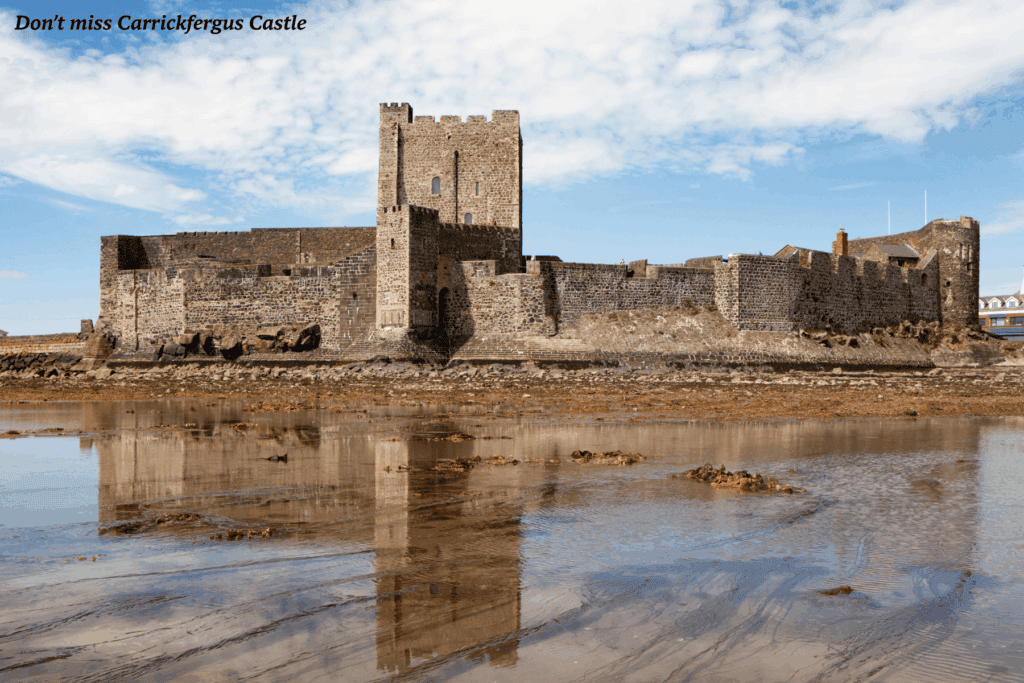
Along the coast of Carrickfergus
North of Carrickfergus, this coastal route offers several scenic stops and walks. In Whitehead, visit the Railway Preservation Society of Ireland Museum to see restored steam trains, then follow a coastal path to Blackhead Lighthouse, where you might spot seals and dolphins.
Nearby, the Gobbins Cliff Path is a dramatic walkway suspended beneath cliffs, though often weather-affected. Inland, Glenoe Waterfall is a peaceful woodland stop. Further along, Larne offers coastal views and nearby parks, before the famous Antrim Coast Road begins, linking attractive villages like Glenarm, Carnlough and Cushendall – all shaped by history, scenery and access to the beautiful Glens of Antrim.
Ballycastle
Ballycastle is definitely a town of two halves, with locals complaining that tourists on the coast road see the harbour but have no idea there’s an attractive market town just up the hill.
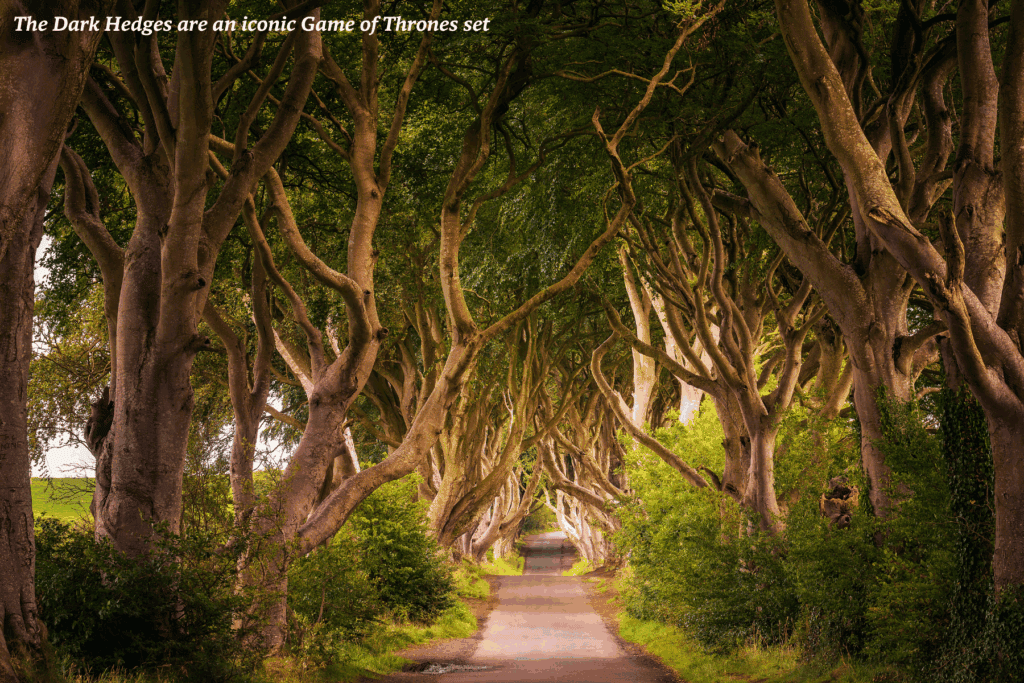
Don’t miss The Dark Hedges, located just 8 miles southwest of the town centre. A beech avenue planted in 1775 to give a grand approach to Gracehill House, over the centuries the trees grew out and across the road, intertwining to create a tunnel-like effect. It is one of the iconic Game of Thrones filming locations and has become more popular in recent years as a result.
The Giant’s Causeway
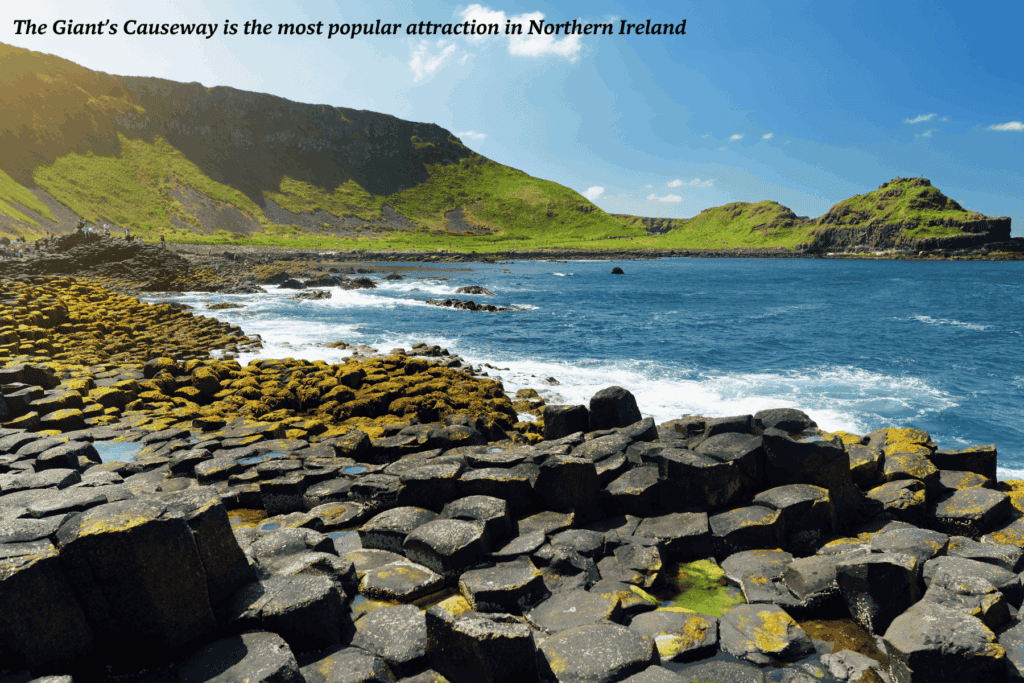
It’s no exaggeration to say that the Giant’s Causeway is the most popular visitor sight in Northern Ireland. Until 2024 it was the only UNESCO World Heritage Site in the country.
Legend has it that Fionn mac Cumhaill (Finn MacCool) – a giant on this occasion, although as a rule he is a regular-sized hero – accepted a challenge from the Scottish giant Benandonner and built the causeway so he could reach Scotland without getting his feet wet. When he saw how big Benandonner was, he hastily retreated, tearing up the middle of the causeway but leaving the far end on the island of Staffa (where Fingal’s Cave is named after him).
Whether you’re drawn by geology or legend, there’s no denying that the Giant’s Causeway is spectacular. Out here, exposed to the wind and sea, the raw elements crashing against the rocks make the landscape feel even more dramatic – bringing to life the myth of Fionn mac Cumhaill in a setting that feels almost otherworldly.
Portrush
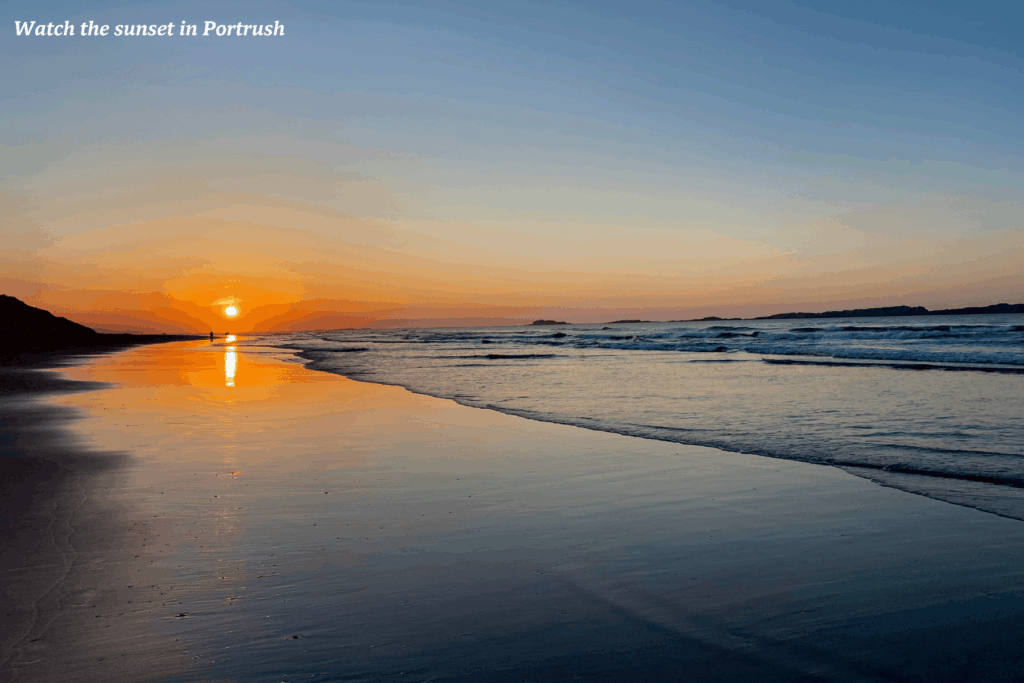
Portrush is Northern Ireland’s surfing capital, with nine main beaches along the Causeway Coast.
From the west, the 7-mile-long Benone Strand is ideal for beginners; Castlerock is for experienced surfers, who come for the right-hand break off the pier at the mouth of the Bann.
Portrush’s West Strand has consistent but usually fairly small waves almost all year; the East Strand is protected from northwest winds by the headland, but in winter it holds some beautiful big waves, although wiping out can be painful.
County Down
County Down is the most varied and in some ways the most tourist-friendly of the six counties, including pleasant Belfast commuter villages, beach resorts and small fishing ports, stately homes, sheltered sea loughs and, above the rest, the dramatic Mourne Mountains.
Newcastle and the Mournes
Ever since 1889, when the Royal County Down Golf Club, one of Ireland’s oldest and finest clubs, opened, Newcastle has positioned itself as a site for active tourism and a base for exploring the Mourne Mountains.
Easily the highest and most dramatic mountains in Northern Ireland, the Mournes were formed a mere 56 million years ago when magma thrust upwards through older rocks and cooled as a massif of hard granite that remained as softer rocks eroded away. Now there are 12 peaks over 600m high in an area of just 15 by 8 miles.
Most hikers heading for the top of Slieve Donard start from Donard Park (where there are two large car parks) on the edge of Newcastle, and follow a path mostly on the north side of the River Glen up to the saddle between Slieve Donard and Slieve Commedagh, turning left there to follow the Mourne Wall for the relatively short but steep push up to the summit. This takes about 4 hours up and 2–3 hours down, so bring plenty of food and water.
As well as views down to Newcastle and the length of its beach, in good weather you should have views northwest to Donegal, south to Wicklow and east to the Isle of Man, Scotland and England.
This is as wild as it gets in Northern Ireland.
County Londonderry
County Londonderry is something of an anomaly in Northern Ireland, existing only since 1613 when the county of Coleraine was broken up during the Plantation.
Outside the city, it’s a largely agricultural county, with a majority Catholic population.
Derry (Londonderry)
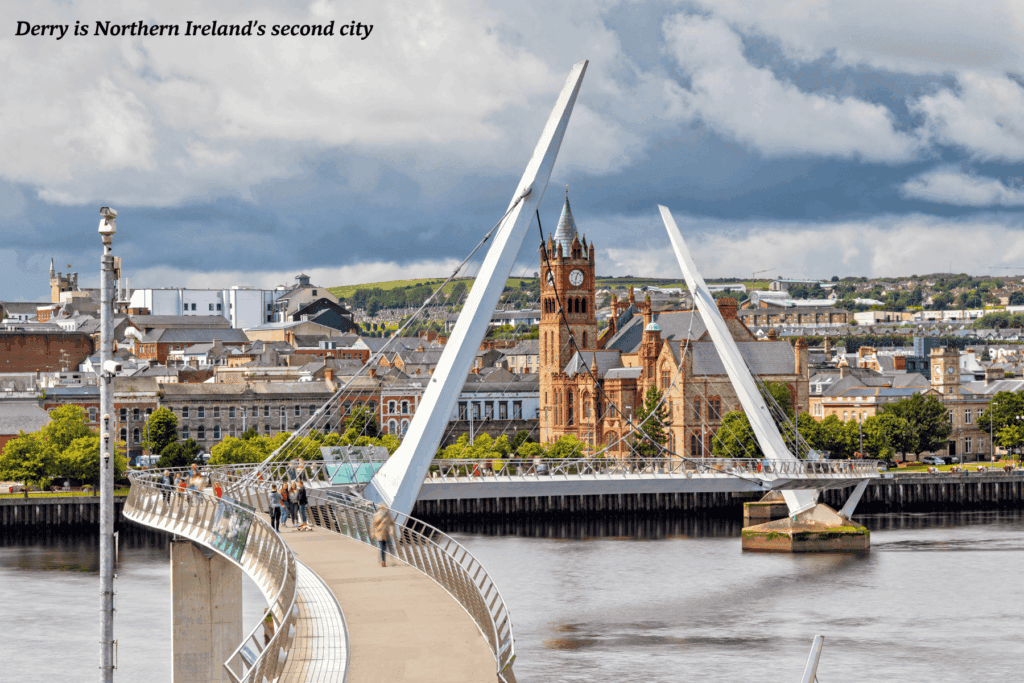
Visitors to County Londonderry typically find themselves drawn to its vibrant heart, the city of Derry, where history, culture and charm are all concentrated within its iconic city walls.
Northern Ireland’s second city is widely known for its role in the 1960s civil rights movement and the start of the Troubles. Now it’s a welcoming place with plenty to see and do.
Start with a walk along the Walls of Londonderry, the most intact walls anywhere in Ireland standing up to 8m high and almost a mile around. The route is easy and scenic. You’ll pass gates, bastions and cannons, taking in excellent views over the city as you go. Highlights include St Columb’s Cathedral, the oldest building inside the walls, and the famous Derry Girls mural.
Nearby, step into the Guildhall, which is magnificent inside, or visit the Tower Museum for the story of the city from archaeological times to the present. For modern history, the Museum of Free Derry offers a fair view of the entire period of the Troubles, while the Peacemakers Museum explains how peace began to take shape here.
Portstewart
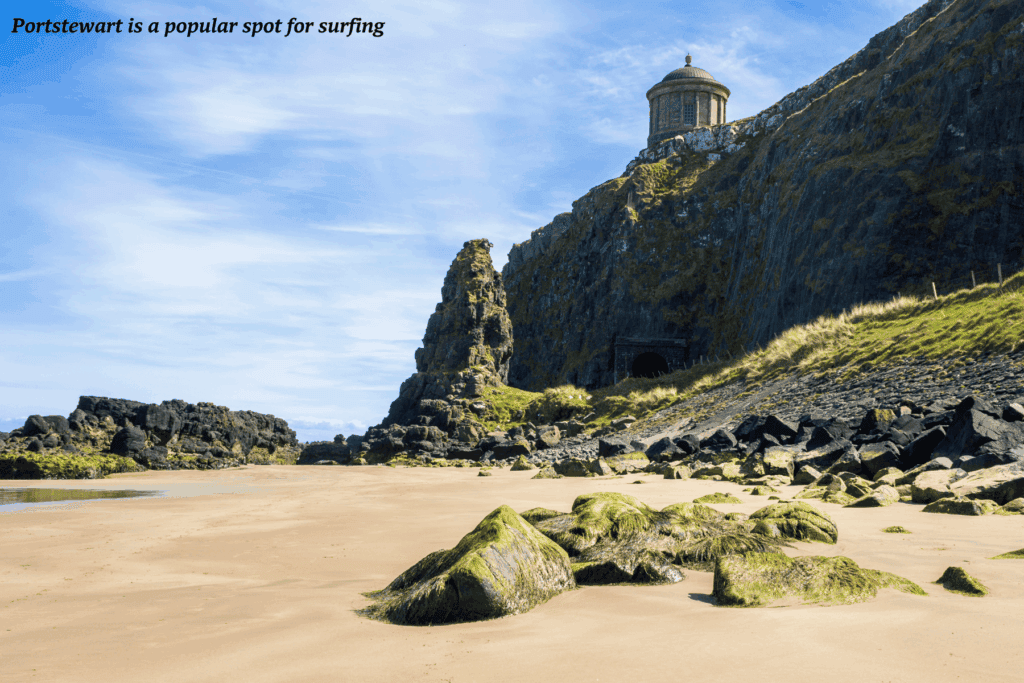
Only founded in 1792, Portstewart grew up as a resort for the Victorian middle classes, and is still affluent, partly due to staff and students of Ulster University living here.
Its setting is delightful, on a bay between rocky headlands with a wide promenade, and a path leading west to the 2-mile sweep of Portstewart Strand, a sandy bar at the mouth of the Bann which offers superb surfing.
The strand is managed by the National Trust, not just to preserve the dune flora and fauna but also to be as accessible and inclusive as possible: beach wheelchairs and floating chairs are provided, along with a 50m strip of matting to reach the water, a cubicle with a hoist, and gender- neutral toilets. At the same time, thanks to the firm sand, it’s the only place in the British Isles where vehicles can simply be driven on to the beach and along it as far as desired to find the perfect picnic spot.
The main landmark, on the southern headland is O’Hara’s Castle, built in 1835 and now a Dominican college.
County Fermanagh
Scraped bare by glaciers, Fermanagh’s landscape is now a lovely mix of lakes, drumlins, woods and green, green fields. It’s by far the least populated of Northern Ireland’s counties, and one of the more Catholic ones too.
Of the three hilly areas around the central Lough Erne, the most interesting for visitors is the Cuilcagh Mountains, to the south on the border with County Cavan; it’s an area of expansive blanket bog on a limestone base, with remarkable caves at Marble Arch and a boardwalk hike in the Cuilcagh Lakelands Geopark.
Enniskillen
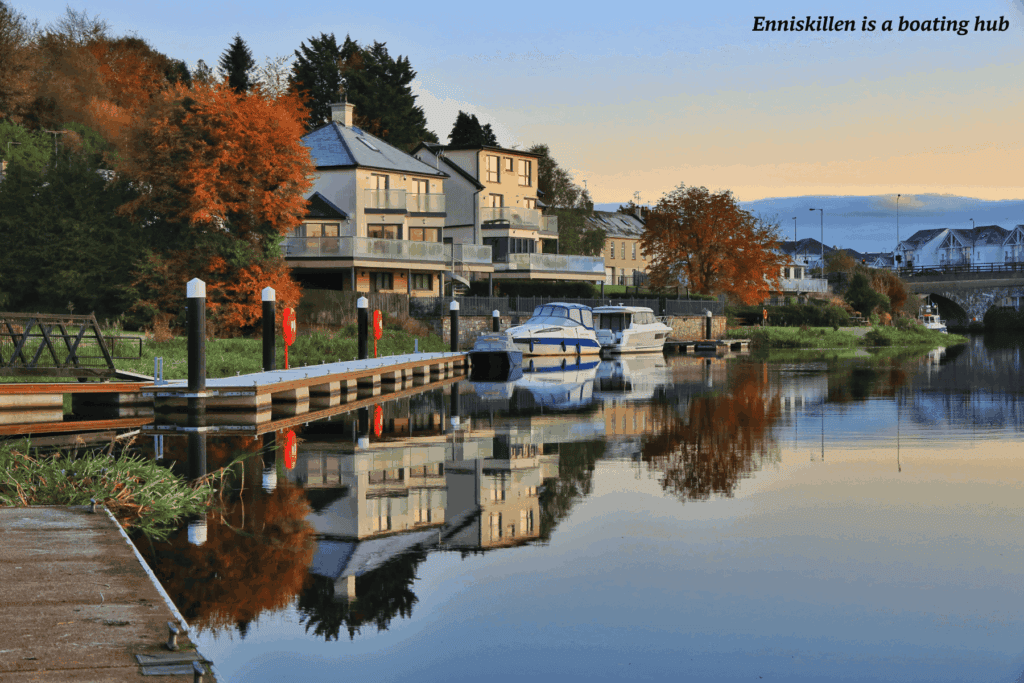
Enniskillen, perched between Upper and Lower Lough Erne, is a compact town brimming with history, from Enniskillen Castle’s museums and the Inniskillings Museum, to Castle Coole’s grand Neoclassical house on the southeastern edge of town.
A walking tour of the main streets takes in St Michael’s Roman Catholic Church, St Macartin’s Cathedral and the Buttermarket (now an arts and crafts studio), while Forthill Park and Cole’s Monument offer sweeping views over the town and lakes when you climb the 108 spiral steps to the top. With its location on the Erne waterways, it also serves as a hub for boating, making it a perfect base to explore both cultural sights and the surrounding scenic landscapes.
Enniskillen is also known for one of the finest pubs in Ireland (Blakes Of The Hollow), and for the Portora Royal School, founded in 1608, where Oscar Wilde, Samuel Beckett and Neil Hannon (of The Divine Comedy) studied, as well as various sportsmen and soldiers.
County Armagh
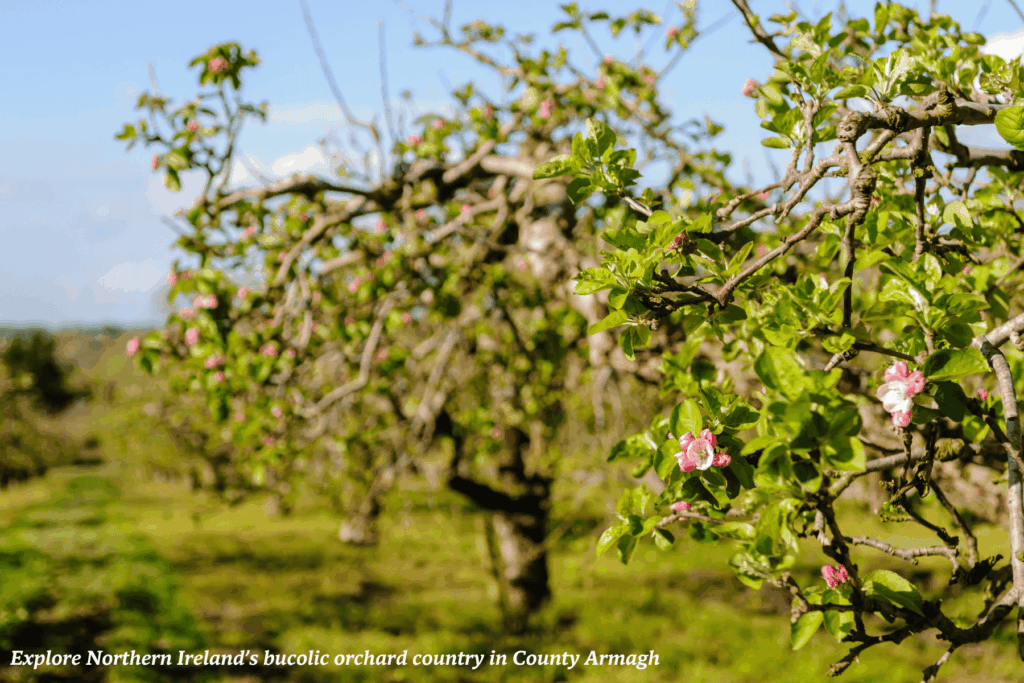
Armagh is a county of very varied parts. Armagh city is Ireland’s ecclesiastical capital, with two cathedrals and some beautiful Georgian buildings; around it is Ireland’s bucolic orchard country (known for its Bramley cooking apples).
The Orange Order was born just north of Armagh, while the solidly Republican far south of the county was dubbed Bandit Country during the Troubles. This should not be confused with the former Linen Triangle, between Armagh and Newry, which became known as the Murder Triangle at the same time.
Armagh City
Take a walk starting at St Patrick’s Cathedral (Church of Ireland) and continue on past the historic Armagh Robinson Library and across the Mall to the striking twin-spired St Patrick’s Roman Catholic Cathedral. Finish by heading up to the Armagh Observatory and Planetarium or spending an afternoon at the Armagh County Museum.
Armagh also hosts some excellent festivals, starting with the Home of St Patrick Festival in the week leading up to 17 March. The Charles Wood Festival of Music, in mid-August, has been one of Northern Ireland’s leading cultural events for over three decades. The Food and Cider Festival takes place over the first weekend of September, and the Georgian Festival, over the last weekend of November, celebrates the city’s 18th-century history and heritage.
Where to go in Northern Ireland: final thoughts
Northern Ireland is a place where landscapes, people and history collide, often in surprising ways.
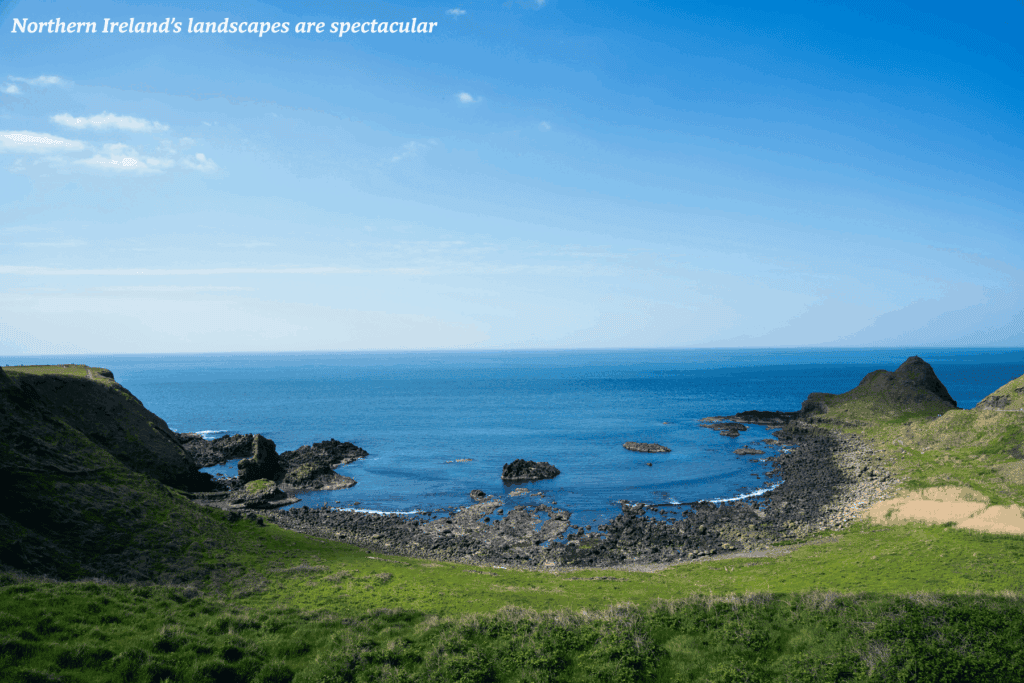
Beyond Belfast’s buzzing centre, the countryside shows a wilder, more rugged side – from the jagged columns of the Giant’s Causeway to the quiet orchards of County Armagh.
Along the way, you’ll encounter local custom, sip whiskey at the iconic Bushmills Distillery, and navigate every type of terrain, from windswept cliffs to tranquil lakes.
Where you go in Northern Ireland will depend on the nature of your tastes and the time that you have. But no matter where you end up, you’ll find it surprising, unpolished and entirely captivating.
Our guide to Northern Ireland
For more information, read our guide to Northern Ireland by Tim Burford: