
New Travel Writer of the Year 2026 – Shortlisted Entries

The following four stories are the shortlisted entries in our 2026 New Travel Writer of the Year Competition. 
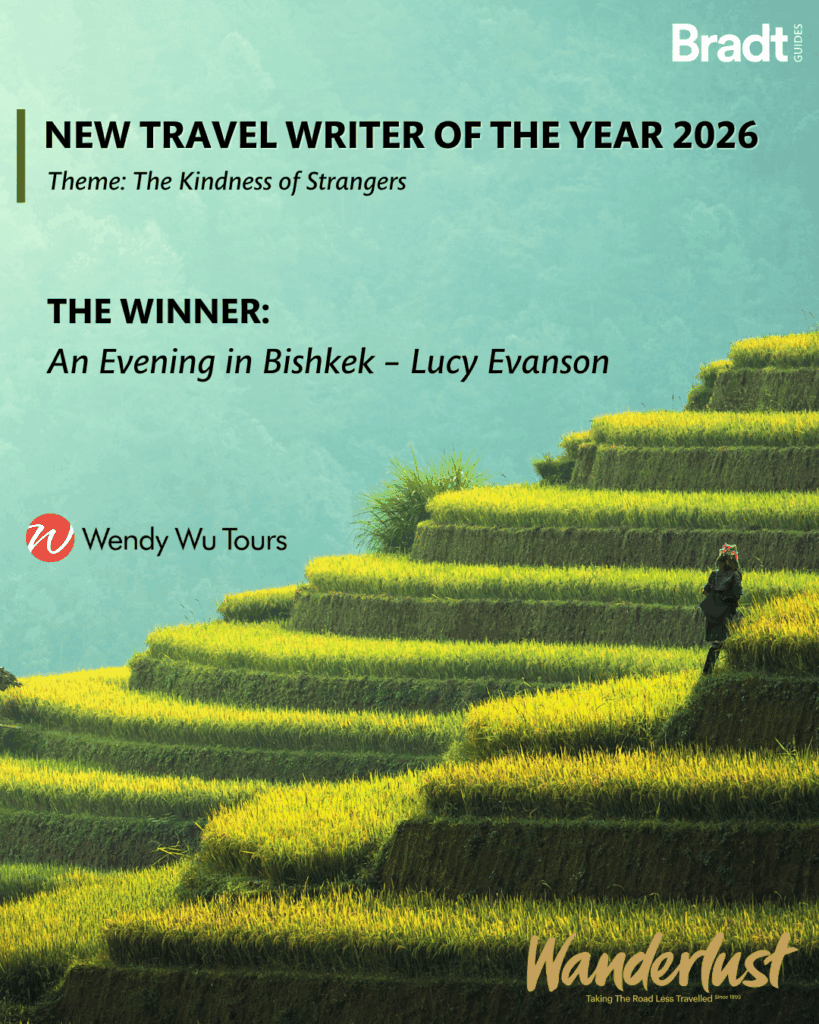
The winner will be announced at the Edward Stanford Travel Writing Awards ceremony in March.

In alphabetical order…

An Evening in Bishkek – Lucy Evanson

Three girls walk into a Mexican restaurant in Bishkek, Kyrgyzstan.

It might not sound like a prime spot for an authentic burrito, but after four months of living in Kazakhstan, a generously-seasoned respite from the delicate taste of boiled horse meat was sorely needed.

Potted cacti, folding chairs, yellow-washed brick. We were laughing, perhaps, a little too loudly, half-drunk on tequila and half on the exhaustion of travel. As twenty-one-year-old girls who laugh too loudly often do, we caught the attention of two local men at a neighbouring table, one overly confident and the other evidently embarrassed by his outgoing friend.

The more outgoing of the two pushed our tables together and ordered a round of shots. Seemingly sensing the skipped heartbeats of lone women approached by men in unfamiliar territory, he reached across the table and momentarily clasped his partner’s hand. A flicker of uncertainty danced across his eyes as he assessed whether his message had been received: we want nothing from you but your company.

Tequila turned to Kyrgyz cognac. Laughter turned to stories of childhoods in Uzbekistan and Kazakhstan, tales of lepyoshka bread sold by grandmothers on street-corners that tasted better than any Parisian baguette ever could. Exhaustion turned to plans to tour the city’s best speakeasies and underground bars, places we’d never be able to find by ourselves, in agreement to not tell our mothers until we woke up alive the next morning.

We set off for one such bar, too caught up in the romance of spontaneity to question our trust in these affable strangers. Outside, the sharp December air iced the ground with a biting sugar-crust. Rogue tendrils of wind coiled in on themselves, suspending fleeting, languid currents of white crystals above the cracked black tarmac.

The steam of our voices warmed the cold silence as we turned into a park, answering questions about life in England as hastily as possible so as to return to stories of grandmothers and bread.

“You chose the right part of the world to visit. You should go to all of the -stans.”

“Where should we go next? Which -stan is your favourite?”

“Oh, definitely Afghanistan.”

“Really?”

“Why wouldn’t it be?”

As we approached a derelict gardeners’ shed, the dirt began to reverberate with a faint bass. Pink light melted into the frosted air from an opening in the rotted patio.

We wobbled our way down a rickety ladder into an old storage basement, or rather, several old storage basements, linked by a series of graffiti-coated tunnels with bare dirt floors. The widest part of this burrow housed a bar made from barrels, accessorised with cracked mirrors, old curtains and haphazard plank-benches, illuminated by a light-and-sound-system that wouldn’t have been out of place in a licensed, above-ground nightclub.

A girl around our age bobbed side-to-side behind the makeshift DJ booth, one tattooed hand resting on the headphones crowning her shaved head and the other reaching down to fiddle with the equipment. The shyer of our two friends let go of his companion’s hand to squeeze his way to the bar.

“Isn’t it dangerous in Afghanistan?”

“Well, yes. But the food is so good, and the people are so nice.”

Bathed in artificial, crimson light, I watched two strangers kiss under an opening to the star-flecked sky. I thought about all of the people lying under those same stars who had to choose between love and survival. Schools reduced to rubble, fathers shot at the dinner table by foreign fighters. Teenage girls looking up at the moon through meshed blue cloth, wondering if their daughters would grow up into a better world.

Our companion returned with five bottles of beer. We clinked their necks, toasting to good health, good drink, and Kyrgyzstan. The food is so good, and the people are so nice.

In The Teeth of the Devil – Chris Baker

You can see them from the mainland on a clear day. That’s what the skipper told us. He said it with conviction too, as if he was trying to reassure himself that it was true. Because today is a day when we can barely see anything. A day when the Golden Gate Bridge floats above us like an outlined apparition, disappearing completely as it climbs into the fog. A day when the roars of the foghorns, rolling across the water with unmistakeable substance, are the only things that tether us to the real world; that tell us we’re not awash in a dream of ethereal greys.

The bright white bow of our small boat leads us into a darkening gloom, across sea the colour and calmness of a sheet of steel, through the Golden Gate and into the Pacific. Towards a group of rocks, cliffs and sea stacks that thrust through the ocean’s surface, 27 miles to the west. The Farallon Islands, they’re called, though days like today helped earn them another name. So many ships were ripped apart on their jagged, fog-shrouded shores, and swallowed by the surrounding seas, that sailors called them The Devil’s Teeth.

Travelling in our bubble of grey, we smell the islands before we see them. The stench could be the Devil’s breath: a tangy, musty miasma of ammonia and rotting seafood that penetrates the fog and spreads across the sea. The odour of accumulated guano; the stink of half a million seabirds. As we get closer to the islands, as sheer cliffs and jutting rocks break through a thinning greyness, we see them too. Cormorants, guillemots, murres, auklets and gulls, arrayed along every clifftop. Squawking, flapping and flying, they circle above beaches thick with seals and sea lions. Our boat hangs off the coast of the fog-shrouded islands, and the seals come to see us, turning the calm water into a churning, whirling melee. Until, without warning, the whirling stops, and a head pokes through the surface of the water, hanging in stillness, watching us with mournful eyes. Checking, for a moment, what we are doing.

Because we are strangers in this watery world of rocks, wings and fins. We humans always have been. And we are strangers who do not come with a record of kindness. In three years in the 1800s, hunters killed more than 150,000 seals on these islands; by the 1840s, there were no seals left. When gold was discovered in the Sierra Nevada and the world rushed to California, the Pacific Egg Company collected half a million murre eggs from the Farallon Islands every year to feed the growing city of San Francisco. The population of murre, once 400,000, decreased to just 6,000 birds. And when we had scraped the islands clean, removed every animal that could be sold, we found a new way to defile them. Between 1945 and 1970, 47,000 barrels of radioactive waste were dumped in the waters around the Farallon Islands.

On a day like today, it is easy to understand why sailors saw the devil here. Jagged rocks fade and reform within swirls of mist, emerging from nowhere beside our boat. Dark and ill-defined, they menace and brood. They are rocks that sunk ships; that claimed human lives. But those events were accidents of geography. They were not planned or systematic; they were not motivated by money. We humans are the ones with the teeth that have bitten and crushed and devoured. We are the devils.

But we can still change.

As our little boat chugs back towards San Francisco, the fog begins to lift. Our world is still grey, but a thinner grey, brightened by rays of sunlight arrowing through the mist. Bright enough that we can see spurts of water flaring from the surface of the sea.

“Humpbacks!” Shouts Becca, the boat’s naturalist, holding a pair of binoculars to her sun-browned face.

We rush to the rail and strain our eyes as Becca scribbles something on a pad. Because this is the purpose of our voyage. The Oceanic Society uses tourist trips to the Farallon Islands to monitor whale populations around one of the world’s busiest shipping lanes. The data that Becca collects – that we collect – is fed to an app called Whale Safe, which provides real-time information to nearby ships. Information they can use to avoid collisions with whales; to protect these animals.

Humans will always be strangers in this world, and right now our legacy is one of unkindness. Of rapacious greed and uncaring indifference. But despite everything that has happened, it is not too late. Human kindness – the kindness of strangers – can support the recovery of this marine environment. Can undo some of the damage. And it’s happening here, on this little boat.

Italian Tourist Dies of Trust – Tommaso Turi

The night before, over biryani in a Lahore hotel and a misplaced sense of confidence, I told another Italian I’d met that travelling in Pakistan was “absolutely fine.”

He was there for work – pale, nervous, scanning the restaurant as if someone might confiscate his passport. I, the self-appointed ambassador of adventure, assured him that Lahore was welcoming, safe, and full of good vegetables. That last point, in retrospect, was catastrophic.

By the next morning I was paying for my optimism in the most literal sense – violently ill, sweating like a broken fountain, and regretting every bite of the previous night’s beetroot salad. My new guide, Bilawal, whom I’d met only hours earlier, looked at me with deep concern and the serene confidence of a man who knew exactly what to do.

“Sir,” he said, “I can take you to the best doctor. In my village.”

His village. The words alone made me clutch my stomach harder. I pictured a long drive into the Punjab countryside, ending in a small hut, perhaps a goat, and my obituary titled Italian Tourist Dies of Trust.

But Bilawal was insistent, radiating sincerity. “He is a specialist,” he explained. “Sufi doctor. He uses herbs – very ancient, very proper. You drink his potion and you will be fine in thirty minutes.”

Thirty minutes. My European medicine hadn’t managed twelve hours. I looked at Bilawal’s hopeful face, the half-finished bottle of electrolyte in my hand, and thought: well, why not? When in Lahore…

The road unravelled into a dusty lane lined with tea stalls and bicycle repair shops. The air was thick with frying dough, petrol, and something herbal – perhaps destiny. When we reached Bilawal’s village, the bazaar was in full swing: shouting vendors, tinny music, and a haze of coriander and smoke.

He led me through a courtyard where dozens queued quietly. At the far end, enthroned behind a counter piled with jars, sat a man who appeared to be at least eighty – extraordinarily thin, wrapped in white cotton, with eyes sharp enough to cut fabric. Behind him rose a wall of herbs in bottles and sacks, like a library of dried miracles. In front, a long wooden bar gleamed with metal cups and pestles. It looked, disconcertingly, like a cocktail lounge for saints.

To my horror, Bilawal marched me straight to the front. No one protested. In Italy, this manoeuvre would have provoked an orchestra of insults and possibly thrown vegetables; here, people simply nodded, as if foreigners leaping queues were part of the day’s entertainment.

The old man studied me in silence for a full ten seconds, then barked a few words in Punjabi. His assistant, a boy of about twelve, set to work mixing powders, water, and what looked suspiciously like condensed milk. A small packet of seeds was wrapped for me in an old edition of The Dawn.

Bilawal translated: “He says you must drink this and chew the seeds. All. Quickly.”

I took a cautious sip. It was white, sweet, and faintly medicinal – imagine a milkshake made by an apothecary. I began dutifully chewing the seeds, which tasted of damp cardboard and determination. Halfway through, the old man snapped his fingers. The boy appeared with a scoop of crushed ice and dropped it into the glass.

Ice. In rural Pakistan. My inner European screamed. Every travel warning, every hygiene lecture, every parental voice since childhood rose in unison: You will die.

Bilawal beamed. “Very good, sir. Now you will feel better.”

I smiled weakly and took another sip, convinced that if the potion didn’t kill me, politeness might.

Yet within thirty minutes, I was fine. Completely fine. The fever vanished, the cramps dissolved, and my stomach felt lighter than my guilt for doubting the Sufi doctor. I stared at Bilawal in disbelief; he grinned like a man who had just proven both science and faith correct.

We drove on, surprisingly cheerful, towards Data Darbar, Lahore’s great Sufi shrine built over the resting place of the saint Ali Hujwiri. The domes shimmered through the haze, and the air carried the scent of rosewater and devotion. Drums echoed somewhere beyond the gates. I felt an absurd sense of reverence – or maybe relief. Perhaps the cure had been less about herbs and more about spirit.

Maybe I didn’t need a doctor after all. Maybe I just needed a miracle.

Water from Empty Hands – Simon Gibbs

I never asked his name.

I can still see the hard light around him – white, softly shared.

He didn’t call out; he didn’t wave. Just sat, still as the land itself.

A small nod. Not the kind that reaches out, but the kind that quietly makes room.

I had been walking alone for days, heading south through the highlands east of the Jordan Valley, following a track that was more memory than road.

By the third day, I’d stopped counting distance; the trail had faded into loose earth.

The air carried the faint sweetness of wild thyme. Heat shimmered on the horizon. Each step sent up a fine dust that clung to skin and boot leather.

It’s a strange thing to need – to feel your strength fall silent and realise you have nothing to offer back but hope. I measured the day by the shrinking stripe of shade at my feet.

My water was gone, and the sun was still unforgiving. My tongue, rough and heavy, lay like a stone in my mouth – and I realised I was closer to needing someone than I cared to admit.

I had braced for suspicion, forgetting how trust still lingers.

And then – him.

He sat cross-legged beneath a stunted acacia tree. The shade was a frail gift in that heat.

His clothes were the colour of the land ahead. His face carried years of sun, and a readiness to welcome.

He cupped his hands, shaping emptiness into an offering, a dark oval of shadow in his palms.

A moment. Then – water, cupped and offered.

He moved with the unhurried ease of someone for whom giving is a habit, not a decision.

He lifted it gently, the way a child shelters a candle.

No words, just a nod – that quiet Bedouin act of ḍiyāfa, that duty to give.

The silence between us settled into something almost like company.

I bent to fill my bottle. “Shukran,” I said – a simple thank you.

The first sip stung like truth; the second steadied me; the third reminded me what it meant to feel alive. His gaze stayed on the horizon, as if generosity needed no witness.

We sat, mirrored in quiet, bound not by words but by being seen.

For a while, I watched the space between us waver, the slow drift of dust motes in the light.

There was no language to bridge that silence, yet I felt something pass between us – as if gratitude itself had shape and weight.

In that stillness, I understood that travel isn’t only movement through the landscape but movement towards others – the fragile, generous space where trust begins. In a land of scarcity, his small gift was enough.

The way ahead was the same – bare, bright, unending – yet it no longer felt empty.

My bottle was full, but more than that, so was I – certain that even in the harshest places, compassion can appear, unmeasured and inexhaustible.

Even now, what stays with me is the simple, steady reminder that we survive through one another.

Every journey, however solitary, depends on unseen hands – the stranger who points the way, the one who shares what little they have, the one who offers shade.

Because of him, what lay before me didn’t feel mine alone. It was stitched together by moments of trust – small, quiet acts binding the world closer, one gesture at a time.

The light softened. The heat eased a little.

The path still wound through the same hard hills, but something in me had made room for it. I walked on, carrying the memory of water from empty hands – a silent testament to all we owe each other.


The following four stories are the winning and shortlisted entries in our 2025 New Travel Writer of the Year Competition. You can find the highly-commended and commended entries here.

WINNING ENTRY

Later or Sooner – Julie Ajdour

Once upon a time, when I was young and fair, I was eating a piece of rhubarb pie with slagroom.

That pie was in a cafe in Castlebar, Ireland.

That cafe was beside a bus stop.

That day, I was bound and determined to take that bus to the Connemara Pony Show.

An ancient gent siddled up to my table. Here’s what he said to me.

“I know where the most beautiful place in the world is, and I’m willing to draw you a map.”

Well, that pie was tart and so was I, but what an opening line. Any lads that may be reading this, take note.

Who would shut such a conversation down?

“Oh, me? I’ve absolutely no interest in learning where the most beautiful place in the world is. Take your stupid map and be off with you.”

Would you say that?

Me neither.

I gave him a napkin to sketch his map. I may or may not have bought him a cup of tea. Probably it was tea with milk. It’s hard to remember as we were always treating strangers to something back in those days and they us. That’s how the world did function then. I do remember that he had no interest in a piece of rhubarb pie, a pie that I was quite smitten with.

He sketched slowly and rambled on.

I kept my eye on the time.

My bus pulled up.

I really wanted that map. Oh, how I wanted that map!

Wouldn’t you?

I slammed down a few pounds, flicked my mane of hair like an impatient pony, and snatched up the napkin. I bid the old gentleman an abrupt farewell and bolted for the bus.

The doors snapped briskly behind me.

And that was that.

The napkin was securely in my handbag, or rather my backpack as that’s what I was carrying that day to the pony show. I wasn’t the handbag sort yet.

Ah, Connemara on that day in August.

The vivid cerise and purple of the fuschia hedges.

The freshness of the fish and the way you could deliberately pick the backbone out of it all in one piece.

The ruffling breeze of the salt air and the way it made a Chantilly cream pony toss its mane.

Everything about the west of Ireland back then, I feel it in my bones like it was yesterday.

*

I did not buy a horse.

I held onto the map. 

Through jobs and childbirth and diapers and carpool and moves here and there and cancer surgery and work,work,work? Through days of feeling gutted like a fish and as if someone had delicately removed my backbone? You’d better believe that I held onto that map. Every snap of my handbag clasp (yes, I was that type now) reminded me of the crisp click of that bus door back in County Galway.

Now I’m much older than that girl. I suppose this is obvious. I’m not so fair anymore either, but this is fine. After all, I am alive. And I excel at passing bone density tests, probably due to insisting on real cream in my coffee. I learned more than one thing in that cafe in Castlebar.

The map did not fade.

It’s rather like something out of a fairy tale.

The destination is the apex of a triangle, not a town.

It’s on the European continent. 

But here’s the hitch.

Can anyplace in the world be more glorious than anticipation?

Can anyplace in the world these days be more exquisite than that August day in the west of Ireland in those times?

Just the sheer taste of that pie…the butteryness of the crust, the rang of the rhubarb, the billow of the Chantilly cream. There was nothing cloying or pretend about that pie. It was full-bodied and real. Delicious surprises are around every corner.

I click that map out of my handbag. 

I hear that same snappy sound that those bus doors made after I bolted from the cafe. My balding, er, maturing husband starts the engine of our rental car.

Meet you at the offramp?

Other Finalists

The Birds of Auschwitz – Sarah Davies

‘The birds do sing at Auschwitz.’

This, the message I sent to my husband as I folded my body quietly into the seat. The coach was full of the teenagers we’d brought a thousand miles to see this. They were witnesses now – ambassadors – their silence a presence, like ghosts thronged at a funeral.

Strange that my first thought was to scotch a myth – to testify to birdsong and not to the empty suitcases, the long barrack rooms full of shoes. They were not all sensible lace-ups. High heels in faded scarlet, coquettish, sat askew as though just kicked off aching feet. You could see the imprint the woman had left in them, imagine the smell of leather and sweat.

In shiny glass cases, though, that stretched from floor to ceiling, from wall to wall, they also seemed sterile, lifeless. There were so incomprehensibly many.

The guides clipped through the rooms, ponytails swinging, brandishing the evidence:

‘Here is all human hair.’

‘This is the punishment cell. The prisoner could not lie or even sit down. Compared to Birkenau, this is like the Hilton.’

‘Here is the courtyard where they were shot.’

The words were like raps on fingers clinging to the cliff of belief in human goodness. They were aimed like bullets from assault rifles, fired into the dark, anticipating sceptics and deniers.

When you’re a History teacher, you spend your daily life flinching as you shine a torch into humanity’s darkest moments. Brush the cobwebs off the manuscripts, smash the museum cases and you find a palimpsest of blood. Your aim is ever to show your students how to quest for truth, but on days when you didn’t sleep, or have to teach Hiroshima twice, you can wish for a sanitised lab or the comfort of mathematics. They see me as a prophetess, the past my crystal ball. Will there be another war? Will the world burn? If there is a God, Miss, how can human beings do this to each other? No, my daily bread does not allow me the silken butter of denial.

‘Here is the gas chamber. This is a small one. Only fifteen hundred people at a time fit in here.’

That was where I stopped. I saw my colleague reach up and touch the wall, eyes closed, praying silently. I took a step backwards, exited the tour, gulping the fresh air.

This was a place hallowed by massacre, where the piled-up ghosts of the murdered shout their admonitions in the chill. But the dead did not feel served by the brisk guiding, the brusque delivery of sharp statistical shards. It seemed unreal: a buffed and polished theme park of death, smelling of wood tar and fresh paint. You try to imagine what cannot be imagined: if that were my hair, those my shoes, would I want them looked at through glass, by crowds of strangers? By someone whose job it is to take a cloth to the case and clean the dust from the floors at night? Or would I want them held to a chest rocked by mourning, worn in a locket next to a loving heart, then laid to rest in the earth at last?

Sinking into my coach seat, I felt processed and assaulted and perhaps that is the right way to feel. The metal detectors and body searches at the entrance, the relentless horror served up by the guides, just a tiny molecule of the flavour of the place. Its lesson: love one another, tolerate differences, do not discriminate, else this will happen again.

My first response, to look for some goodness and light; to tell tales of birdsong.

*

That night, we went with the students to experience a ‘Polish Night’. There were dumplings in every course and, dense with dough, we braced ourselves for the entertainment. 

Heavily-moustached accordion players danced with abandon, defying gravity. They whirled with the music, a hypnotic kaleidoscope of lace and sweat. Drunk with tiredness, we lacked the strength to resist them when they pulled us into the fray. We were ridiculous – flung and flipped by men with fake horses, fierce grip and fireworks of facial hair.

We laughed until we cried. It was the volcanic sort of laughter which erupts and bends you double: it scours your soul of heaviness like a spin cycle in your gut. We held on to each other, tears rolling down red cheeks, as we led the way back through the streetlamp-light of Krakow. 

We were exhausted that night, but by God we were fully alive. That, in the end, seemed the best remedy for death – living loudly in the present; trying a little harder to make someone smile; listening for birds at Auschwitz. 

A Dance with Duende – Rebecca Legros

Capering along quiet alleyways, my heels hit hard on the cobbles with a rhythm that resounds the footwork of a flamenco dancer. Footsteps follow in my wake, I’m sure, but I spring along, carefree and too caught up in the energy of the evening.

It’s the dead of night and the deserted side streets are my shortcut home. I pulse with the evocative performance at the tablao bar I’ve left behind, concealed among the cave dwellings of Sacromonte – an out-of-the-way neighbourhood high in the hills above Granada – long the refuge of gypsies, and deeply rooted in the traditional dance of Spain. I step and stride to the strains of the passionate singing that fills my head, giddy with emotion.

The stillness of the streets echoes the late hour. I’ve walked this way – with friends and alone – many times after a night at a bar or flamenco club. I know the twists and turns from the hills of Sacromonte to the AlbaicÍn, the Moorish quarter I call home in my new life in Andalusia.

The footfalls are getting closer. But I am unflappable. Sangria infused. Feeling my full wits about me in almost picaresque fashion. Under false pretences, I’m as daring as the Artful Dodger, as impassioned as Don Quixote. I own these dark streets.

Distant sounds linger in the small hours; the vague voices of passersby walking parallel pathways, muffled music from bars still open for business, the slurred throttle of scooters on the main street somewhere below. 

I loop through the labyrinth of age-old callejuelas; alleyways that are the beating heart of medieval Granada. In the daytime, this tangle of streets is an exquisite tableau of tight-knit whitewashed buildings and terracotta rooftops. Bougainvillea in vivid shades add colour pops to cobblestoned courtyards. The scent of pomegranate and persimmon, lemon and fig, permeate from trees bearing fruits of the season.

I love this city, and I dance and dip and skip. I am roused by the intensity of tonight’s performers; a cuadro of artists expressing their rich cultural heritage. A sole guitarist, a solemn singer and an inflamed dancer, improvising their sensual story of love and loss in our intimate smoky setting.

I round a corner into the Mirador San Nicolás, a panoramic plaza with the Alhambra Palace – that gargantuan fortress of Moorish majesty – gloriously illuminated on the opposite hillside. The square holds a few strays only at this hour. A lost soul strums a guitar and laments his woes to a straggle of bystanders. I look around for those earlier footsteps. Nothing.

Almost home. I cross to an alley and continue on my way.

Entrada

… the beginning of the act. The bailaora (dancer) is motionless as she lets the music seize her. I suddenly stand stock-still. Quickening strides are closing in on me. Eyes shut, she loses herself in the haunting voice of the cantaor (singer), the rhythmic clapping of the audience, the trembling notes of the tacaor (guitarist).

A macabre silence steps in, but my head still pounds with the mournful strains of the cantaor. Electrified by the emotions of the duet, the bailaora begins her expressive dalliance. Her body swirls and writhes, her arms draw graceful gestures, her face is tight with the explosive torment within, the soles of her feet strike the floor in harmony. She embodies the spirit of her suffering in the music. A hand on my waist spins me round, a vuelta beyond my control. In a flash, I face terror.

 Desplante

… the boldness of the act. The bailaora intensifies her intricate dance to the sharpened strums of the tacaor. A brazenness takes over and a fierce climax fuels the spectacle as she reels and rotates with rapture. My attacker reveals his bravado. Tight in his grip, I catch the glint of the blade he brandishes. The weight of his bulk imbues the blackness. He is blatant in the act, a bullfighter asserting his banderilla for a strike. I am strangely removed, but rebellion is surging inside.

Salida

… the finale. In an intense dénouement, the bailaora’s display triumphs and transcends into ‘duende’. Exhilarated, she achieves the soul of her art. Her performance is done. Tense and entrapped, an almost primeval outburst takes hold. Deep from within, I let out a cry. A wail that imitates the intensely woeful sound of the cantaor. Piercing and overpowering, hard and hoarse and intimidating to my enemy. Seconds ago, an assailant wielding a weapon seized me, and just as suddenly he is gone. He disappears into the darkness, fearful of duende, the spirit of the dancer in me.

Panicked, but proud of my performance, I sprint the last stretch home. I won’t be defeated. I too have achieved the power of duende; this city has given me its soul.

A Vital Warning Ignored – Jacqui Hitt

The carriage door slammed shut, and the sardine-can-of-a-train juddered into motion. Then we saw them. A group of young men in the shadows. Half-drunk and staring at us narrow-eyed; hungry, as if they couldn’t believe their luck.

I’d seen their type before, hanging out on dingy park corners in Belgrade, dressed in torn black jeans and jackets, with poorly cut hair and reeking of Russian cigarettes. Usually a bottle of beer or plum brandy held against their chapped lips. Able to turn on the charm, but beneath the surface, restless, arrogant and full of ire.

An empty glass bottle clink clinked against the carriage wall in rhythm with the moving train. Patsy and I looked at each other. Remembered what my host mother had said. “Do NOT take the slow train,” had been her exact words. “They’re not safe! Particularly for foreign young women like you.”  Now, stood feet away from us, was the reason for her warning.

The train laboured on, swaying from side to side like a boat in high swell, accompanied by an unceasing high-pitched rasp: the sound of rusting wheels scraping across rocking rails. Hearts pounding, the bitter taste of coal dust caught in the back of our throats. This wasn’t an adventure Patsy, or I, wanted.

Sliding out of their plastic seats, the gang slunk closer. With a twisted grin, the tallest one leant towards me, shoved an open bottle in my face. “Have a swig!” he insisted. Another leered, while his mate slurred suggestive words in Serbian. The oldest looking one, greedily eyed Patsy’s long blond hair and the bags between my feet. Even though we hadn’t said a single word, they had worked out we were foreign. Fair game in other words. Not fellow passengers but prey.

The men were around us then. Taunting. Thrusting. Toying. All they wanted was a little ‘zabava’. Never had the word for fun sounded so menacing. One put his arm around Patsy and whispered in her ear. Another grabbed my shoulder, roughly pulled me to my feet. Surrounded and outnumbered, we knew the danger we were in.

Then, the train came to a shuddering halt, and a middle-aged man in a wide-brimmed cap and well-worn uniform appeared through the door. The gang shrank back, but not before the conductor had seen the terror in our eyes. Taking swift control, he motioned us to follow him. We stumbled out onto the dark platform, our bags held tightly in shaking hands. As we walked over to the tiny ticket office, the gang followed like a pack of pacing hyenas. They hadn’t given up the chase. We waited in the office, watched the slow train pull away.

“There will be another one along any moment now,” the conductor reassured us. “A faster, busier one. An express.” There was no point calling the police, he explained, because he had a plan. He knew how to get us safely back to Belgrade. “Trust me,” he said. “I have two daughters about your age…” Then a loud whistle screamed, and another train pulled in, and out of a small side door we slipped. The gang were too busy quarrelling amongst themselves to notice our escape.

The conductor did have a plan. A simple and effective one. Rather than putting us in an empty compartment, he ushered us into one occupied by a large local family: an old grandmother, her two burly middle-aged sons, their wives and assorted offspring. In hushed but rapid Serbian, the conductor explained the predicament we were in.

“It will be a squash, but hide these young women,” he said. “Keep them out of sight. Save them from that gang of young men.” He nodded in the direction of the men pushing and shoving each other angrily on the platform outside.

Without wavering, the family did exactly as requested. Patsy was huddled on the floor beneath a pile of the children’s coats, while I was squeezed into a corner and covered from head to toe in the grandmother’s thick woollen shawl. The sons stood guard at the compartment door as the conductor wished us well and departed, slamming the door tight shut. A lock clicked, another whistle blew, and the express train picked up speed. In a matter of moments, the sound of the gang shouting obscenities faded into the cold, fog-bound night.

When we were safely on our way, the wives unwrapped us, offered us water, cake and sweets. The kids sang cheeky songs and began playing cards. The grandmother hugged me. “You are OK now,” she said. “Did no-one tell you NEVER to take a slow train? Certainly not nice, young, foreign girls like you.”


The following four stories are the winning and shortlisted entries in our 2025 New Travel Writer of the Year Competition. You can find the highly-commended and commended entries here.

WINNING ENTRY

Later or Sooner – Julie Ajdour

Once upon a time, when I was young and fair, I was eating a piece of rhubarb pie with slagroom.

That pie was in a cafe in Castlebar, Ireland.

That cafe was beside a bus stop.

That day, I was bound and determined to take that bus to the Connemara Pony Show.

An ancient gent siddled up to my table. Here’s what he said to me.

“I know where the most beautiful place in the world is, and I’m willing to draw you a map.”

Well, that pie was tart and so was I, but what an opening line. Any lads that may be reading this, take note.

Who would shut such a conversation down?

“Oh, me? I’ve absolutely no interest in learning where the most beautiful place in the world is. Take your stupid map and be off with you.”

Would you say that?

Me neither.

I gave him a napkin to sketch his map. I may or may not have bought him a cup of tea. Probably it was tea with milk. It’s hard to remember as we were always treating strangers to something back in those days and they us. That’s how the world did function then. I do remember that he had no interest in a piece of rhubarb pie, a pie that I was quite smitten with.

He sketched slowly and rambled on.

I kept my eye on the time.

My bus pulled up.

I really wanted that map. Oh, how I wanted that map!

Wouldn’t you?

I slammed down a few pounds, flicked my mane of hair like an impatient pony, and snatched up the napkin. I bid the old gentleman an abrupt farewell and bolted for the bus.

The doors snapped briskly behind me.

And that was that.

The napkin was securely in my handbag, or rather my backpack as that’s what I was carrying that day to the pony show. I wasn’t the handbag sort yet.

Ah, Connemara on that day in August.

The vivid cerise and purple of the fuschia hedges.

The freshness of the fish and the way you could deliberately pick the backbone out of it all in one piece.

The ruffling breeze of the salt air and the way it made a Chantilly cream pony toss its mane.

Everything about the west of Ireland back then, I feel it in my bones like it was yesterday.

*

I did not buy a horse.

I held onto the map. 

Through jobs and childbirth and diapers and carpool and moves here and there and cancer surgery and work,work,work? Through days of feeling gutted like a fish and as if someone had delicately removed my backbone? You’d better believe that I held onto that map. Every snap of my handbag clasp (yes, I was that type now) reminded me of the crisp click of that bus door back in County Galway.

Now I’m much older than that girl. I suppose this is obvious. I’m not so fair anymore either, but this is fine. After all, I am alive. And I excel at passing bone density tests, probably due to insisting on real cream in my coffee. I learned more than one thing in that cafe in Castlebar.

The map did not fade.

It’s rather like something out of a fairy tale.

The destination is the apex of a triangle, not a town.

It’s on the European continent. 

But here’s the hitch.

Can anyplace in the world be more glorious than anticipation?

Can anyplace in the world these days be more exquisite than that August day in the west of Ireland in those times?

Just the sheer taste of that pie…the butteryness of the crust, the rang of the rhubarb, the billow of the Chantilly cream. There was nothing cloying or pretend about that pie. It was full-bodied and real. Delicious surprises are around every corner.

I click that map out of my handbag. 

I hear that same snappy sound that those bus doors made after I bolted from the cafe. My balding, er, maturing husband starts the engine of our rental car.

Meet you at the offramp?

Other Finalists

The Birds of Auschwitz – Sarah Davies

‘The birds do sing at Auschwitz.’

This, the message I sent to my husband as I folded my body quietly into the seat. The coach was full of the teenagers we’d brought a thousand miles to see this. They were witnesses now – ambassadors – their silence a presence, like ghosts thronged at a funeral.

Strange that my first thought was to scotch a myth – to testify to birdsong and not to the empty suitcases, the long barrack rooms full of shoes. They were not all sensible lace-ups. High heels in faded scarlet, coquettish, sat askew as though just kicked off aching feet. You could see the imprint the woman had left in them, imagine the smell of leather and sweat.

In shiny glass cases, though, that stretched from floor to ceiling, from wall to wall, they also seemed sterile, lifeless. There were so incomprehensibly many.

The guides clipped through the rooms, ponytails swinging, brandishing the evidence:

‘Here is all human hair.’

‘This is the punishment cell. The prisoner could not lie or even sit down. Compared to Birkenau, this is like the Hilton.’

‘Here is the courtyard where they were shot.’

The words were like raps on fingers clinging to the cliff of belief in human goodness. They were aimed like bullets from assault rifles, fired into the dark, anticipating sceptics and deniers.

When you’re a History teacher, you spend your daily life flinching as you shine a torch into humanity’s darkest moments. Brush the cobwebs off the manuscripts, smash the museum cases and you find a palimpsest of blood. Your aim is ever to show your students how to quest for truth, but on days when you didn’t sleep, or have to teach Hiroshima twice, you can wish for a sanitised lab or the comfort of mathematics. They see me as a prophetess, the past my crystal ball. Will there be another war? Will the world burn? If there is a God, Miss, how can human beings do this to each other? No, my daily bread does not allow me the silken butter of denial.

‘Here is the gas chamber. This is a small one. Only fifteen hundred people at a time fit in here.’

That was where I stopped. I saw my colleague reach up and touch the wall, eyes closed, praying silently. I took a step backwards, exited the tour, gulping the fresh air.

This was a place hallowed by massacre, where the piled-up ghosts of the murdered shout their admonitions in the chill. But the dead did not feel served by the brisk guiding, the brusque delivery of sharp statistical shards. It seemed unreal: a buffed and polished theme park of death, smelling of wood tar and fresh paint. You try to imagine what cannot be imagined: if that were my hair, those my shoes, would I want them looked at through glass, by crowds of strangers? By someone whose job it is to take a cloth to the case and clean the dust from the floors at night? Or would I want them held to a chest rocked by mourning, worn in a locket next to a loving heart, then laid to rest in the earth at last?

Sinking into my coach seat, I felt processed and assaulted and perhaps that is the right way to feel. The metal detectors and body searches at the entrance, the relentless horror served up by the guides, just a tiny molecule of the flavour of the place. Its lesson: love one another, tolerate differences, do not discriminate, else this will happen again.

My first response, to look for some goodness and light; to tell tales of birdsong.

*

That night, we went with the students to experience a ‘Polish Night’. There were dumplings in every course and, dense with dough, we braced ourselves for the entertainment. 

Heavily-moustached accordion players danced with abandon, defying gravity. They whirled with the music, a hypnotic kaleidoscope of lace and sweat. Drunk with tiredness, we lacked the strength to resist them when they pulled us into the fray. We were ridiculous – flung and flipped by men with fake horses, fierce grip and fireworks of facial hair.

We laughed until we cried. It was the volcanic sort of laughter which erupts and bends you double: it scours your soul of heaviness like a spin cycle in your gut. We held on to each other, tears rolling down red cheeks, as we led the way back through the streetlamp-light of Krakow. 

We were exhausted that night, but by God we were fully alive. That, in the end, seemed the best remedy for death – living loudly in the present; trying a little harder to make someone smile; listening for birds at Auschwitz. 

A Dance with Duende – Rebecca Legros

Capering along quiet alleyways, my heels hit hard on the cobbles with a rhythm that resounds the footwork of a flamenco dancer. Footsteps follow in my wake, I’m sure, but I spring along, carefree and too caught up in the energy of the evening.

It’s the dead of night and the deserted side streets are my shortcut home. I pulse with the evocative performance at the tablao bar I’ve left behind, concealed among the cave dwellings of Sacromonte – an out-of-the-way neighbourhood high in the hills above Granada – long the refuge of gypsies, and deeply rooted in the traditional dance of Spain. I step and stride to the strains of the passionate singing that fills my head, giddy with emotion.

The stillness of the streets echoes the late hour. I’ve walked this way – with friends and alone – many times after a night at a bar or flamenco club. I know the twists and turns from the hills of Sacromonte to the AlbaicÍn, the Moorish quarter I call home in my new life in Andalusia.

The footfalls are getting closer. But I am unflappable. Sangria infused. Feeling my full wits about me in almost picaresque fashion. Under false pretences, I’m as daring as the Artful Dodger, as impassioned as Don Quixote. I own these dark streets.

Distant sounds linger in the small hours; the vague voices of passersby walking parallel pathways, muffled music from bars still open for business, the slurred throttle of scooters on the main street somewhere below. 

I loop through the labyrinth of age-old callejuelas; alleyways that are the beating heart of medieval Granada. In the daytime, this tangle of streets is an exquisite tableau of tight-knit whitewashed buildings and terracotta rooftops. Bougainvillea in vivid shades add colour pops to cobblestoned courtyards. The scent of pomegranate and persimmon, lemon and fig, permeate from trees bearing fruits of the season.

I love this city, and I dance and dip and skip. I am roused by the intensity of tonight’s performers; a cuadro of artists expressing their rich cultural heritage. A sole guitarist, a solemn singer and an inflamed dancer, improvising their sensual story of love and loss in our intimate smoky setting.

I round a corner into the Mirador San Nicolás, a panoramic plaza with the Alhambra Palace – that gargantuan fortress of Moorish majesty – gloriously illuminated on the opposite hillside. The square holds a few strays only at this hour. A lost soul strums a guitar and laments his woes to a straggle of bystanders. I look around for those earlier footsteps. Nothing.

Almost home. I cross to an alley and continue on my way.

Entrada

… the beginning of the act. The bailaora (dancer) is motionless as she lets the music seize her. I suddenly stand stock-still. Quickening strides are closing in on me. Eyes shut, she loses herself in the haunting voice of the cantaor (singer), the rhythmic clapping of the audience, the trembling notes of the tacaor (guitarist).

A macabre silence steps in, but my head still pounds with the mournful strains of the cantaor. Electrified by the emotions of the duet, the bailaora begins her expressive dalliance. Her body swirls and writhes, her arms draw graceful gestures, her face is tight with the explosive torment within, the soles of her feet strike the floor in harmony. She embodies the spirit of her suffering in the music. A hand on my waist spins me round, a vuelta beyond my control. In a flash, I face terror.

 Desplante

… the boldness of the act. The bailaora intensifies her intricate dance to the sharpened strums of the tacaor. A brazenness takes over and a fierce climax fuels the spectacle as she reels and rotates with rapture. My attacker reveals his bravado. Tight in his grip, I catch the glint of the blade he brandishes. The weight of his bulk imbues the blackness. He is blatant in the act, a bullfighter asserting his banderilla for a strike. I am strangely removed, but rebellion is surging inside.

Salida

… the finale. In an intense dénouement, the bailaora’s display triumphs and transcends into ‘duende’. Exhilarated, she achieves the soul of her art. Her performance is done. Tense and entrapped, an almost primeval outburst takes hold. Deep from within, I let out a cry. A wail that imitates the intensely woeful sound of the cantaor. Piercing and overpowering, hard and hoarse and intimidating to my enemy. Seconds ago, an assailant wielding a weapon seized me, and just as suddenly he is gone. He disappears into the darkness, fearful of duende, the spirit of the dancer in me.

Panicked, but proud of my performance, I sprint the last stretch home. I won’t be defeated. I too have achieved the power of duende; this city has given me its soul.

A Vital Warning Ignored – Jacqui Hitt

The carriage door slammed shut, and the sardine-can-of-a-train juddered into motion. Then we saw them. A group of young men in the shadows. Half-drunk and staring at us narrow-eyed; hungry, as if they couldn’t believe their luck.

I’d seen their type before, hanging out on dingy park corners in Belgrade, dressed in torn black jeans and jackets, with poorly cut hair and reeking of Russian cigarettes. Usually a bottle of beer or plum brandy held against their chapped lips. Able to turn on the charm, but beneath the surface, restless, arrogant and full of ire.

An empty glass bottle clink clinked against the carriage wall in rhythm with the moving train. Patsy and I looked at each other. Remembered what my host mother had said. “Do NOT take the slow train,” had been her exact words. “They’re not safe! Particularly for foreign young women like you.”  Now, stood feet away from us, was the reason for her warning.

The train laboured on, swaying from side to side like a boat in high swell, accompanied by an unceasing high-pitched rasp: the sound of rusting wheels scraping across rocking rails. Hearts pounding, the bitter taste of coal dust caught in the back of our throats. This wasn’t an adventure Patsy, or I, wanted.

Sliding out of their plastic seats, the gang slunk closer. With a twisted grin, the tallest one leant towards me, shoved an open bottle in my face. “Have a swig!” he insisted. Another leered, while his mate slurred suggestive words in Serbian. The oldest looking one, greedily eyed Patsy’s long blond hair and the bags between my feet. Even though we hadn’t said a single word, they had worked out we were foreign. Fair game in other words. Not fellow passengers but prey.

The men were around us then. Taunting. Thrusting. Toying. All they wanted was a little ‘zabava’. Never had the word for fun sounded so menacing. One put his arm around Patsy and whispered in her ear. Another grabbed my shoulder, roughly pulled me to my feet. Surrounded and outnumbered, we knew the danger we were in.

Then, the train came to a shuddering halt, and a middle-aged man in a wide-brimmed cap and well-worn uniform appeared through the door. The gang shrank back, but not before the conductor had seen the terror in our eyes. Taking swift control, he motioned us to follow him. We stumbled out onto the dark platform, our bags held tightly in shaking hands. As we walked over to the tiny ticket office, the gang followed like a pack of pacing hyenas. They hadn’t given up the chase. We waited in the office, watched the slow train pull away.

“There will be another one along any moment now,” the conductor reassured us. “A faster, busier one. An express.” There was no point calling the police, he explained, because he had a plan. He knew how to get us safely back to Belgrade. “Trust me,” he said. “I have two daughters about your age…” Then a loud whistle screamed, and another train pulled in, and out of a small side door we slipped. The gang were too busy quarrelling amongst themselves to notice our escape.

The conductor did have a plan. A simple and effective one. Rather than putting us in an empty compartment, he ushered us into one occupied by a large local family: an old grandmother, her two burly middle-aged sons, their wives and assorted offspring. In hushed but rapid Serbian, the conductor explained the predicament we were in.

“It will be a squash, but hide these young women,” he said. “Keep them out of sight. Save them from that gang of young men.” He nodded in the direction of the men pushing and shoving each other angrily on the platform outside.

Without wavering, the family did exactly as requested. Patsy was huddled on the floor beneath a pile of the children’s coats, while I was squeezed into a corner and covered from head to toe in the grandmother’s thick woollen shawl. The sons stood guard at the compartment door as the conductor wished us well and departed, slamming the door tight shut. A lock clicked, another whistle blew, and the express train picked up speed. In a matter of moments, the sound of the gang shouting obscenities faded into the cold, fog-bound night.

When we were safely on our way, the wives unwrapped us, offered us water, cake and sweets. The kids sang cheeky songs and began playing cards. The grandmother hugged me. “You are OK now,” she said. “Did no-one tell you NEVER to take a slow train? Certainly not nice, young, foreign girls like you.”


More information

For more information about our New Travel Writer of the Year competition and what it involves, head to our competitions page.